Numb Lip After Wisdom Teeth? Here's What's Normal
Last Updated: July 10, 2026
🕒 11 min read

Written by DMD Alexander K.
Doctor of Dental Medicine, 10+ years of clinical experience, focused on preventive dentistry and patient education. Learn more on the About page.

Table of Contents
Is this normal, or did something go wrong? 🦷
You expected pain.
You got swelling, you got the puffy chipmunk cheeks, you got the soft-food diet you were warned about.
What you didn’t expect: your lip and chin feel like they belong to someone else. Numb. Rubbery. You bit your own lip while drinking coffee and didn’t feel it happen — you just saw it.
That’s not what “recovering from surgery” was supposed to feel like. So here’s the honest answer before anything else: this is a known, well-documented side effect, and in the overwhelming majority of cases it fixes itself. [5,6]
It’s not rare enough to panic over, and not common enough that nobody warned you — you were probably told about it in the consent conversation before surgery, in the part everyone half-listens to because the appointment itself is the scary bit. This is that fine print, actually happening.
🦷 This article is part of our Adult Oral Health Guide. No lectures about flossing. Just the common dental problems, explained properly, and what to actually do about them.
Related Reads 🔗

Face Swelled Up and Feels Like Bubble Wrap? Here's Why
That crackling feeling under your skin isn't a bruise or an allergy — it's air, and it happened during your dental work. Here's why, calmly.
Bruised Cheek After a Dental Injection? What It Means
A dental injection isn't supposed to leave a bruise — but sometimes it does. Here's why, how long it lasts, and when it's actually a problem.

How to Know If a Dentist Is Good: 10 Trustworthy Signs
Not sure if your dentist is any good? Here are 10 trustworthy signs that help patients choose the right dentist — and avoid the ones they shouldn’t trust.
What’s actually happening (the nerve, not the tooth) 🔬
Here’s the anatomy nobody draws you a picture of at the consult.
Running through your lower jawbone is a nerve called the inferior alveolar nerve — a branch of a larger nerve system that supplies feeling to your lower teeth, gums, chin, and lower lip. [1,2] It travels through a bony tunnel that, in a lot of people, sits extremely close to the roots of the lower wisdom teeth. Sometimes close enough that the roots are practically wrapped around it.
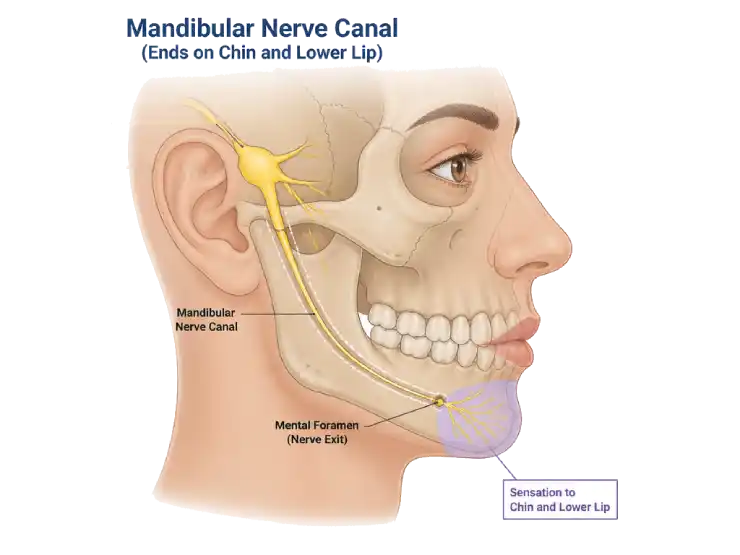
From brain to the chin and lip, there is a wisdom tooth root that can reach the canal where the nerve runs. This is why numbness can happen after wisdom tooth removal, the signals get interrupted during the nerve injury.
When that tooth gets removed, the nerve is sitting right there in the surgical field. It doesn’t take a mistake to bruise it — proximity alone is often enough. The injury usually comes from one of a few mechanisms: [5,7]
- Pressure or a crush injury from the instruments used to loosen the tooth
- A nick from the rotary tool used to section the tooth or remove bone
- Simple stretching, from the force needed to lift a stubborn tooth out
- Swelling or a small blood clot after surgery pressing on the nerve from outside
There’s also a second, less commonly injured nerve — the lingual nerve, which runs along the inner surface of the jawbone and supplies the tongue. Injury there causes numbness or altered taste on one side of the tongue instead of the lip. [1,3] Less common, same general story.
Same injection, different structures — a punctured vessel bruises , a constricted one blanches , and tight palatal tissue just gets sore . Worth knowing which one you actually have.
None of this means your surgeon did anything wrong. In a genuine number of cases, the nerve and the tooth root are simply neighbors close enough that contact during extraction is nearly unavoidable — which is exactly why root proximity gets checked on imaging before surgery in the first place, not after.
How long numbness normally lasts — and what changes the timeline ⏱️
Most of this resolves faster than the anxious 2 a.m. search results suggest.
The big picture number: roughly 90–96% of nerve injuries after wisdom tooth removal resolve on their own, typically within 4–8 weeks, sometimes taking up to 6 months. [5,6,7]
One detailed study that tracked patients whose nerve was visibly exposed during surgery — meaning the surgeon could actually see it during the procedure — found this recovery curve: [7]
- At 1 week, about 20% still had some altered sensation
- By 3 months, close to 58% of those had recovered
- By 6 months, about 66% had recovered
- By 1 year, roughly 71% had recovered
- At 2 years, only about 2% of all patients in the study still had lasting numbness
Recovery moves fastest in the first three to six months. If nothing’s changed by the six-month mark, full recovery becomes less likely — not impossible, just less likely. [6,7] True permanent injury, the kind that never resolves, happens in somewhere around 0.3–1% of cases. [5,6] Rare. Real, but rare.
What pushes your timeline one way or the other:
- Age — being over 30 is linked to slower, less complete recovery. Each additional year nudges the odds slightly [5,6,7]
- How much sensation was there at the one-week mark — some feeling detectable early is a good sign; complete numbness at one week is a slower-recovery pattern [6]
- Whether the nerve was visibly touched during surgery — if your surgeon mentions the nerve was exposed, that’s a real risk factor for a longer road, not just a scary line in your chart [5,7]
- How deeply impacted the tooth was — teeth fully buried in bone carry a meaningfully higher nerve-injury rate than teeth that were only partially covered or barely under the gum [5]
None of these are things you controlled. They were mostly decided before you ever sat in the chair — by your anatomy and how the tooth happened to grow in.
Numbness vs. nerve damage: the real difference 🧠
This is where the language gets confusing, so let’s be precise about it.
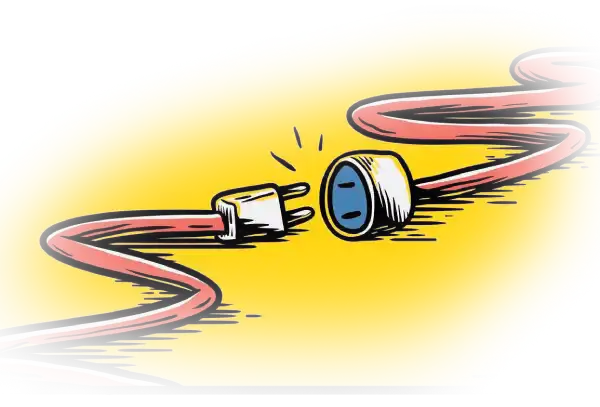
Numbness is a symptom. Nerve damage is a cause. Almost everyone with post-extraction numbness technically has some degree of nerve injury — the nerve was bruised, stretched, or irritated. What varies enormously is the severity of that injury, and severity is what actually predicts the outcome.
Mild injuries — a bruise, a stretch, some irritation — heal the way bruises heal: gradually, on their own, with feeling returning in patches before it’s fully back. This describes the vast majority of cases. [5,6]
More serious injuries — where nerve fibers are actually torn or where scar tissue forms around the nerve — are less common and take longer, sometimes needing a specialist to intervene. [6] This is where the word “damage” starts to feel more accurate than “numbness,” but even then, some recovery is often possible with time or, if needed, a targeted procedure.
A useful way to think about it: if you have some sensation — even faint, patchy, or delayed — that’s evidence the nerve is still functionally connected, and the odds favor continued improvement. Complete, total absence of feeling that isn’t budging by the one-week mark is the pattern worth flagging to your surgeon specifically, not just noting and waiting on quietly. [6]
Occasionally the nerve heals but heals “wrong” — sending confused signals that register as burning, tingling, or an unpleasant buzzing rather than plain numbness. That’s called dysesthesia, and it’s a different animal from simple numbness — it usually needs its own management, sometimes with medication typically used for nerve pain rather than just watching and waiting. [5]
What to do while you wait ⏳
Mostly: not much, and that’s by design.
In the first week:
- Follow your surgeon’s aftercare instructions exactly — this matters more for nerve recovery than it feels like it should
- Keep your scheduled follow-up appointment. This is typically when your surgeon actually tests the nerve — light touch, a gentle pinprick check, comparing both sides — rather than just asking “does it feel weird?” [5]
- Be careful with hot food and drinks on the numb side. You genuinely cannot feel a burn happening in real time, and that’s a real risk, not a hypothetical one
- Watch for accidental lip or cheek biting, especially with kids or anyone prone to chewing on their lip out of habit — numb tissue doesn’t send the “stop, that hurts” signal until well after the damage is done
Ongoing, through the following weeks and months:
- Gently test the area yourself — a light touch with a clean finger, noticing if sensation is returning in patches
- Keep your follow-up appointments even once you feel like nothing’s changing; steady monitoring is how a surgeon knows whether you’re on the 90%+ recovery track or need a closer look
- Don’t self-diagnose off internet symptom lists. Numbness that’s isolated to the lip and chin, with no pain involved, is a fundamentally different situation from throbbing pain radiating toward the ear a few days after surgery — that second pattern points toward dry socket, a completely separate complication, not a nerve issue at all

There’s no home remedy that speeds up nerve healing. No supplement, no exercise, no specific food. Time and monitoring are the actual protocol here, and that’s not doctors being dismissive — that’s what the evidence supports. [5,6]
When to actually call your oral surgeon 📞
Most of this resolves without you ever needing to make an extra call. Make one anyway if:
- There’s still complete, total numbness with zero sensation at your one-week follow-up
- Nothing has changed by three months — this is typically when a surgeon starts seriously considering referral for specialist evaluation if recovery has stalled [5]
- The area develops a burning, buzzing, or painful quality instead of plain numbness — that’s dysesthesia, and it benefits from earlier attention rather than a wait-and-see approach [5]
- You notice taste changes or numbness on your tongue, which points toward the lingual nerve rather than the lip nerve — worth mentioning specifically, since it’s a related but separate injury [1,3]
If there’s no improvement by three months, referral to a specialist for further evaluation — sometimes including surgical exploration of the nerve itself — is a legitimate next step, not an overreaction. [5,6] Surgical repair, when it’s actually needed, has a reasonably good track record: roughly 74% of cases see meaningful improvement, though “meaningful improvement” and “back to exactly how it felt before” aren’t always the same thing. [5]
This whole conversation — the risk, the odds, what happens if it doesn’t resolve — is also exactly what should have been part of your consent discussion before surgery. [1,4,6] If it wasn’t, or if it felt rushed, that’s worth remembering for next time. The value of choosing the right practitioner isn’t abstract — it shows up specifically in moments like this one, in how thoroughly the risk was explained before the drill ever touched bone, and in how seriously a follow-up call gets taken if something doesn’t track the expected timeline.
Bottom line 🎯
A numb lip after wisdom tooth removal is a nerve that got bruised, stretched, or irritated during a procedure where it was sitting inches — sometimes millimeters — from the action. [1,2,5]
For the vast majority of people, this resolves on its own within weeks to a few months. [5,6,7] Complete, permanent numbness is uncommon, and even when recovery is slow, most cases are still trending toward “better,” not “stuck.”
What earns a phone call isn’t the numbness itself — it’s numbness that’s total at one week, unchanged at three months, or that starts feeling like burning instead of nothing at all. Everything else is patience, monitoring, and not biting your own lip while it’s still asleep.
Related Reads 🔗
- How to Find a Good Dentist: 10 Trustworthy Signs
- Do You Need a Dental Crown?
- Adult Oral Health — Full Topic Guide
How to Know If a Dentist Is Good: 10 Trustworthy Signs
Not sure if your dentist is any good? Here are 10 trustworthy signs that help patients choose the right dentist — and avoid the ones they shouldn’t trust.
Do You Really Need a Dental Crown After Root Canal?
When to crown and when can wait. Learn how to make a final decision and when to explore other options.
Bruised Cheek After a Dental Injection? What It Means
A dental injection isn't supposed to leave a bruise — but sometimes it does. Here's why, how long it lasts, and when it's actually a problem.

Gum Turned White After a Dental Injection? What It Means
A pale white patch right after the needle isn't the same as a sore that shows up days later. Here's the difference — and when to actually worry.
Roof of Mouth Sore After a Dental Injection? Why It Hurts
Not every sore on the palate is a canker sore. Here's why palatal injections leave the roof of your mouth aching — and how long it should last.
Sources
- [1] Moosa Z, Malden N. Investigation of nerve injury after lower third molar removal. *Oral Surgery*. 2017;11(1):22-27. DOI: 10.1111/ors.12284
- [2] Ridaura-Ruiz L, Figueiredo R, Valmaseda-Castellon E, Berini-Aytes L, Gay-Escoda C. Sensibility and taste alterations after impacted lower third molar extractions. A prospective cohort study. *Medicina Oral Patología Oral y Cirugia Bucal*. 2012;17(5):e759-e764. DOI: 10.4317/medoral.17890
- [3] Janakiraman EN, Alexander M, Sanjay P. Prospective analysis of frequency and contributing factors of nerve injuries following third-molar surgery. *Journal of Craniofacial Surgery*. 2010;21(3):784-786. DOI: 10.1097/scs.0b013e3181d7f29a
- [4] Sarikov R, Juodzbalys G. Inferior alveolar nerve injury after mandibular third molar extraction: a literature review. *Journal of Oral and Maxillofacial Research*. 2014;5(4):e1. DOI: 10.5037/jomr.2014.5401
- [5] Kang F, Sah MK, Fei G. Determining the risk relationship associated with inferior alveolar nerve injury following removal of mandibular third molar teeth: A systematic review. *Journal of Stomatology, Oral and Maxillofacial Surgery*. 2020;121(1):63-69. DOI: 10.1016/j.jormas.2019.06.010
- [6] Robinson PP, Loescher AR, Yates JM, Smith KG. Current management of damage to the inferior alveolar and lingual nerves as a result of removal of third molars. *British Journal of Oral and Maxillofacial Surgery*. 2004;42(4):285-292. DOI: 10.1016/j.bjoms.2004.02.024
- [7] Tay ABG, Go WS. Effect of exposed inferior alveolar neurovascular bundle during surgical removal of impacted lower third molars. *Journal of Oral and Maxillofacial Surgery*. 2004;62(5):592-600. DOI: 10.1016/j.joms.2003.08.033
- [8] Grant S, Sivarajasingam V. Incidence of inferior alveolar and lingual nerve paraesthesia following mandibular third molar extractions: a retrospective audit of 236 cases. *British Journal of Oral and Maxillofacial Surgery*. 2011;49:S60. DOI: 10.1016/j.bjoms.2011.03.104
FAQ: Numb Lip After Wisdom Teeth: Real Answers ❓
How long should my lip stay numb after wisdom tooth removal?
Why do my lips feel numb after tooth extraction?
Why won't the numbness go away after a few days?
When should I worry about lip numbness after dental work?
How can I tell if the dentist or surgeon hit a nerve?
What are the signs of nerve damage after wisdom teeth removal?
How long does nerve damage last after an extraction?
What can I do to help the numbness resolve faster?
Is an oral surgeon liable if nerve damage occurs?
🦷 Part of our Adult Oral Health Guide
This article is part of our Adult Oral Health Guide, where we break down the most common dental problems and how to actually deal with them.
About the Author: DMD Alexander K.
Doctor of Dental Medicine with clinical experience treating adults and children. This site focuses on practical prevention, symptom education, and helping patients make informed decisions.
Learn more on the About page.