Why Pregnancy Hurts Your Teeth (Will It Go Back to Normal)
Last Updated: June 11, 2026
🕒 10 min read

Written by DMD Alexander K.
Doctor of Dental Medicine, 10+ years of clinical experience, focused on preventive dentistry and patient education. Learn more on the About page.
Table of Contents
Short answer 🚀
Your gums are bleeding because pregnancy hormones make gum tissue overreact to bacteria that were never a problem before.
Your teeth are not losing calcium to the baby.
That’s a myth.
Almost everything reverses after delivery.
Almost is doing a lot of work in that sentence — and we’ll get to it.
🦷 Part of our Adult Oral Health Guide
This article is part of our Adult Oral Health Guide, where we break down the most common dental problems and how to actually deal with them.
What’s actually happening in your mouth 🔬
By the third trimester, progesterone runs about 10 times higher than its normal peak.
Estrogen runs 30 times higher. [1]
Your gum tissue has receptors for both.
When those levels spike, three things happen at once.
Your immune system stands down — on purpose.
Pregnancy suppresses immune response so your body doesn’t attack the fetus.
The white blood cells that normally patrol your mouth and keep plaque in check lose some of their ability to move and kill bacteria. [1,5]
The security guards are still there.
They’re just not allowed to do their job.
The bacteria in your mouth change.
Species linked to gum disease — Prevotella intermedia, Porphyromonas gingivalis — become more abundant.
Here’s the part nobody mentions: these bacteria can actually use estrogen and progesterone as growth factors. [1]
Rising hormone levels literally feed the bacteria that cause inflammation.
Your gum blood vessels get leakier.
Progesterone increases vascular permeability in gum tissue.
Gums swell.
That’s why a toothbrush that caused zero problems six months ago is now leaving red in the sink. [4]
This is called pregnancy gingivitis.
It affects somewhere between 30% and 100% of pregnant women, depending on the population studied. [1]
That range is wide for a reason — oral hygiene and pre-existing gum health make a real difference.
What you’ll notice, when 📅
Symptoms usually start around the second month and worsen into the second and third trimesters. [1,7]
First trimester
Gums start looking slightly redder and feeling more sensitive.
Morning sickness brings stomach acid into your mouth — repeatedly.
Brushing feels unpleasant.
Oral hygiene slips at exactly the wrong moment.
Second trimester
Bleeding on probing reaches its highest point. [7]
Gums look swollen and dark red.
Pockets between tooth and gum deepen — mostly from swelling, not actual tissue destruction.
Third trimester
Symptoms peak.
About 0.2–9.6% of women develop a pyogenic granuloma — a red nodular growth on the gum that bleeds easily. [2]
The name sounds serious.
It isn’t.
It’s an overgrowth of inflamed tissue.
It usually disappears after birth without treatment.
Some women also notice their teeth feel slightly loose in late pregnancy.
This resolves postpartum in the overwhelming majority of cases. [8]
“Pregnancy steals calcium from your teeth” 🦷
No.
A 1943 study measured the mineral content of teeth extracted from pregnant women and compared them to non-pregnant controls.
The difference: not significant. [9]
A comprehensive review confirmed it: “teeth do not soften — no significant withdrawal of calcium or other minerals occurs during pregnancy.” [10]
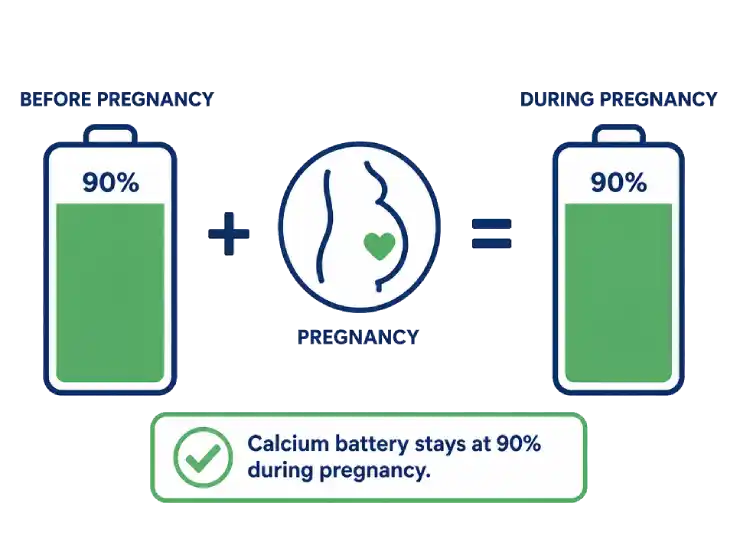
The fetus draws calcium for its skeleton from your diet.
If your diet is insufficient, it comes from your bones.
Not your teeth.
Enamel and dentin are not a reservoir the body can tap.
Then why do some women get more cavities during pregnancy?
Because the environment in your mouth changes — not the structure of your teeth.
- Salivary calcium drops in the second and third trimesters, reducing your mouth’s ability to repair early enamel damage [3,4]
- Salivary pH drops, creating a more acidic environment where cavity-causing bacteria thrive
- Streptococcus mutans counts increase significantly during the second trimester [11]
- Morning sickness acid, sugar cravings, more frequent snacking, and oral hygiene that slips because brushing triggers the gag reflex
The cavities come from the environment.
Not the baby.
Will everything go back to normal? ✅
For most women — yes.
Multiple studies tracked the same women from early pregnancy through postpartum.
Gum inflammation, bleeding, and pocket depths all returned to pre-pregnancy levels within 3 to 6 months after delivery. [1,7,8]
One 2017 study followed 96 women from weeks 8–10 of pregnancy through 40 days postpartum.
Bleeding scores rose from 57% to 75% during the third trimester — then fell back to 59% after delivery. [8]
Crucially: no studies found permanent bone or ligament loss in women who entered pregnancy with healthy gums. [1,7]
The deepened pockets? Swollen gum tissue. Not destroyed bone.
The exception:
If you had gum disease before pregnancy, the hormonal changes will worsen it — and it may not fully resolve without treatment.
Pregnancy doesn’t cause periodontitis.
It amplifies whatever was already there.
Is it safe to go to the dentist? 🦺
Yes.
Unambiguously yes.
The American Congress of Obstetricians and Gynecologists and the American Academy of Pediatrics both recommend that pregnant women continue regular dental care. [12,13]
Postponing necessary treatment is the actual risk.
Untreated infections spread.
Periodontal disease has been linked to preterm birth and low birth weight. [12,13]
Local anesthesia
Lidocaine — the standard dental anesthetic — is FDA Pregnancy Category B.
Animal studies show no risk.
Human studies show no harm. [13]
A study followed 210 pregnant women who received dental local anesthetics — 53% during the first trimester — and found no significant difference in birth defect rates compared to unexposed controls. [14]
The dose used in a dental appointment is a fraction of what an epidural delivers.
Epidurals are routine.
The anxiety about dental anesthesia is disproportionate to the evidence.
X-rays
A standard dental bitewing delivers 0.005 millisieverts of radiation.
The threshold where radiation begins to pose measurable fetal risk is 50 mSv. [14]
You’d need roughly 10,000 bitewing X-rays to approach that level.
For emergencies: take the X-ray.
For routine work: use judgment, lead apron, thyroid collar.
Routine cleaning
Not just safe.
Recommended.
Professional cleaning removes tartar that brushing cannot, and reducing plaque load partially neutralizes the hormonal amplification effect on your gums. [1]
Which trimester is safest? 🗓️
Second trimester (weeks 14–27). That’s the clinical consensus. [12,13]
First trimester: Organ formation is happening. Evidence doesn’t show dental procedures cause harm, but most guidelines suggest postponing elective work during weeks 4–10 as a precaution. Also — morning sickness makes appointments genuinely miserable.
Second trimester: Organ formation is complete. Miscarriage risk has dropped. The uterus isn’t yet large enough to cause discomfort in the dental chair. This is the window.
Third trimester: Fine for short procedures. Lengthy elective work is better after delivery — lying flat compresses major blood vessels and causes dizziness. Dentists manage this by tilting the chair.
Emergency treatment: Happens whenever it needs to happen.
Severe pain, swelling, abscess, infection — treat it immediately, regardless of trimester.
No guideline suggests waiting.
Postpone until after delivery: teeth whitening, elective orthodontics, purely cosmetic procedures.
What actually helps 🛠️
Brushing — twice daily with fluoride toothpaste.
High estrogen + high plaque together create significantly more gingivitis than either factor alone. [5]
You can’t eliminate the hormones.
You can control the plaque.
Flossing — daily. Not optional during pregnancy.
After vomiting — rinse with a baking soda solution (one teaspoon in a glass of water) to neutralize the acid.
Wait 30 minutes before brushing.
Brushing immediately after acid exposure scrubs temporarily softened enamel.
Professional cleaning — at minimum once during pregnancy, ideally in the second trimester.
Mouthwash — chlorhexidine-based can help with bacterial load during pregnancy.
Check with your dentist before using it long-term.
Alcohol-based mouthwashes: best avoided.
Diet — reduce the frequency of sugary snacks, not just the amount.
Every sugar exposure gives cavity bacteria 20 minutes of acid production.
Three meals with sugar is different from grazing all day.
When to call a dentist 📞
Call if:
- Gums are severely swollen, painful, or showing pus
- A nodular growth appears on the gum that bleeds on contact
- A tooth feels significantly loose
- Toothache or sensitivity that doesn’t settle within a day or two
- Any swelling in the jaw or face
Don’t wait out dental pain during pregnancy hoping it resolves.
An abscess that spreads is a genuine risk to both you and the baby.
Bottom line 🧠
Pregnancy changes your mouth for nine months.
For most women — it changes back.
The gum inflammation is real but temporary.
The calcium myth is false.
The cavity risk is real but preventable.
The dental appointments are safe and worth keeping.
Your mouth doesn’t get a pass because you’re growing a human.
If anything, it needs more attention.
Not less.
If you’re already dealing with bleeding gums that predated pregnancy, the bleeding gums guide covers the non-pregnancy causes in detail.
For finding the right dentist during pregnancy:
Once the baby arrives, the clock starts on their teeth too:
Related reads 🔗

Sources
- [1] Wu M, Chen SW, Jiang SY. Relationship between gingival inflammation and pregnancy. *Mediators of Inflammation*. 2015. DOI: 10.1155/2015/623427
- [2] Kapila YL. Periodontology and pregnancy. *Periodontology 2000*. 2021;87(1):132-149. DOI: 10.1111/prd.12394
- [3] Figuero E et al. Gingival changes during pregnancy. *Journal of Clinical Periodontology*. 2010;37(3):220-229. DOI: 10.1111/j.1600-051x.2009.01516.x
- [4] O'Neil TCA. Plasma female sex-hormone levels and gingivitis in pregnancy. *Journal of Periodontology*. 1979;50(6):279-282. DOI: 10.1902/jop.1979.50.6.279
- [5] Gürsoy M et al. High salivary estrogen and risk of developing pregnancy gingivitis. *Journal of Periodontology*. 2013;84(9):1237-1244. DOI: 10.1902/jop.2012.120512
- [6] Balan P et al. Keystone species in pregnancy gingivitis. *Frontiers in Microbiology*. 2018;9:2360. DOI: 10.3389/fmicb.2018.02360
- [7] Gürsoy M et al. Clinical changes in periodontium during pregnancy and post-partum. *Journal of Clinical Periodontology*. 2008;35(7):576-583. DOI: 10.1111/j.1600-051x.2008.01236.x
- [8] González-Jaranay M et al. Periodontal status during pregnancy and postpartum. *PLoS ONE*. 2017;12(5):e0178234. DOI: 10.1371/journal.pone.0178234
- [9] Deakins M, Looby J. Effect of pregnancy on the mineral content of dentin. *American Journal of Obstetrics and Gynecology*. 1943. DOI: 10.1016/s0002-9378(15)32919-7
- [10] Laine MA. Effect of pregnancy on periodontal and dental health. *Acta Odontologica Scandinavica*. 2002;60(5):257-264. DOI: 10.1080/00016350260248210
- [11] Baad RK et al. Estimation of DMFT, salivary Streptococcus mutans count, flow rate, pH, and salivary total calcium in pregnant and non-pregnant women. *Journal of Clinical and Diagnostic Research*. 2017. DOI: 10.7860/jcdr/2017/24965.9516
- [12] Lee JM, Shin TJ. Use of local anesthetics for dental treatment during pregnancy. *Journal of Dental Anesthesia and Pain Medicine*. 2017;17(2):81-90. DOI: 10.17245/jdapm.2017.17.2.81
- [13] Miozza E et al. Pregnancy and Dentistry: A Literature Review. *Dentistry Journal*. 2021;9(4):46. DOI: 10.3390/dj9040046
- [14] Hagai A et al. Pregnancy outcome after in utero exposure to local anesthetics as part of dental treatment. *Journal of the American Dental Association*. 2015;146(8):572-580. DOI: 10.1016/j.adaj.2015.04.002
- [15] Michalowicz BS et al. Examining the Safety of Dental Treatment in Pregnant Women. *Journal of the American Dental Association*. 2008;139(6):685-695. DOI: 10.14219/jada.archive.2008.0250
FAQ: Pregnancy and Teeth: Real Answers ❓
When do teeth problems start in pregnancy?
Will my teeth go back to normal after pregnancy?
Does pregnancy make your teeth hurt?
How common is it to lose teeth during pregnancy?
Does pregnancy gingivitis go away?
Is tooth extraction safe during pregnancy?
Which trimester is not safe for dental treatment?
What dental procedures cannot be done while pregnant?
How to stop pregnancy from ruining your teeth?
What does pregnancy gingivitis feel like?
What happens if you have a cavity while pregnant?
Is it normal to have sensitive teeth during pregnancy?
🦷 Part of our Adult Oral Health Guide
This article is part of our Adult Oral Health Guide, where we break down the most common dental problems and how to actually deal with them.
About the Author: DMD Alexander K.
Doctor of Dental Medicine with clinical experience treating adults and children. This site focuses on practical prevention, symptom education, and helping patients make informed decisions.
Learn more on the About page.