Bruised Cheek After a Dental Injection? What It Means
Last Updated: July 13, 2026
🕒 11 min read

Written by DMD Alexander K.
Doctor of Dental Medicine, 10+ years of clinical experience, focused on preventive dentistry and patient education. Learn more on the About page.

Table of Contents
Wait, why do I have a bruise on my face? 💉
You went in for a filling. Or a root canal. Maybe just a cleaning that needed a little numbing first.
You did not go in expecting to leave with a purple mark spreading across your cheek like you lost a fight with a doorframe.
Here’s the reassurance first: this is a documented, known complication of a routine injection, not a sign your dentist did something wrong. [1,3] It happens because of where the needle has to go, not because of a mistake in how it got there.
Numbing your mouth means putting a needle very close to some genuinely major blood vessels. Sometimes “very close” becomes “directly into.” That’s the whole story behind most of these bruises.
🦷 Part of our Adult Oral Health Guide
This article is part of our Adult Oral Health Guide, where we break down the most common dental problems and how to actually deal with them.
What’s actually happening (vessel puncture, not the injection itself failing) 🔬
Your face and jaw are packed with blood vessels feeding the muscles, skin, and bone in that area — which is exactly why a needle going in for anesthesia has real vessels to contend with, not just soft tissue.

The most common culprit — a small artery nobody taught you about.
There’s a small branch of the artery supplying the upper back teeth that runs close to the bone in the upper jaw, right in the path of injections given for upper molars. [1] Anatomical studies found this vessel is bound tightly to the surrounding tissue, which means it can’t roll out of the way the way a floating vessel might when a needle approaches. [1] When it gets nicked, the bleeding is fast and arterial — which is exactly why some bruises seem to bloom almost instantly, right in front of you, rather than showing up the next morning.
The runner-up — a network of veins behind the upper jaw.
Slightly deeper and further back sits a cluster of veins that can also be a source, particularly if the needle goes in too deep or at too steep an angle. [1]
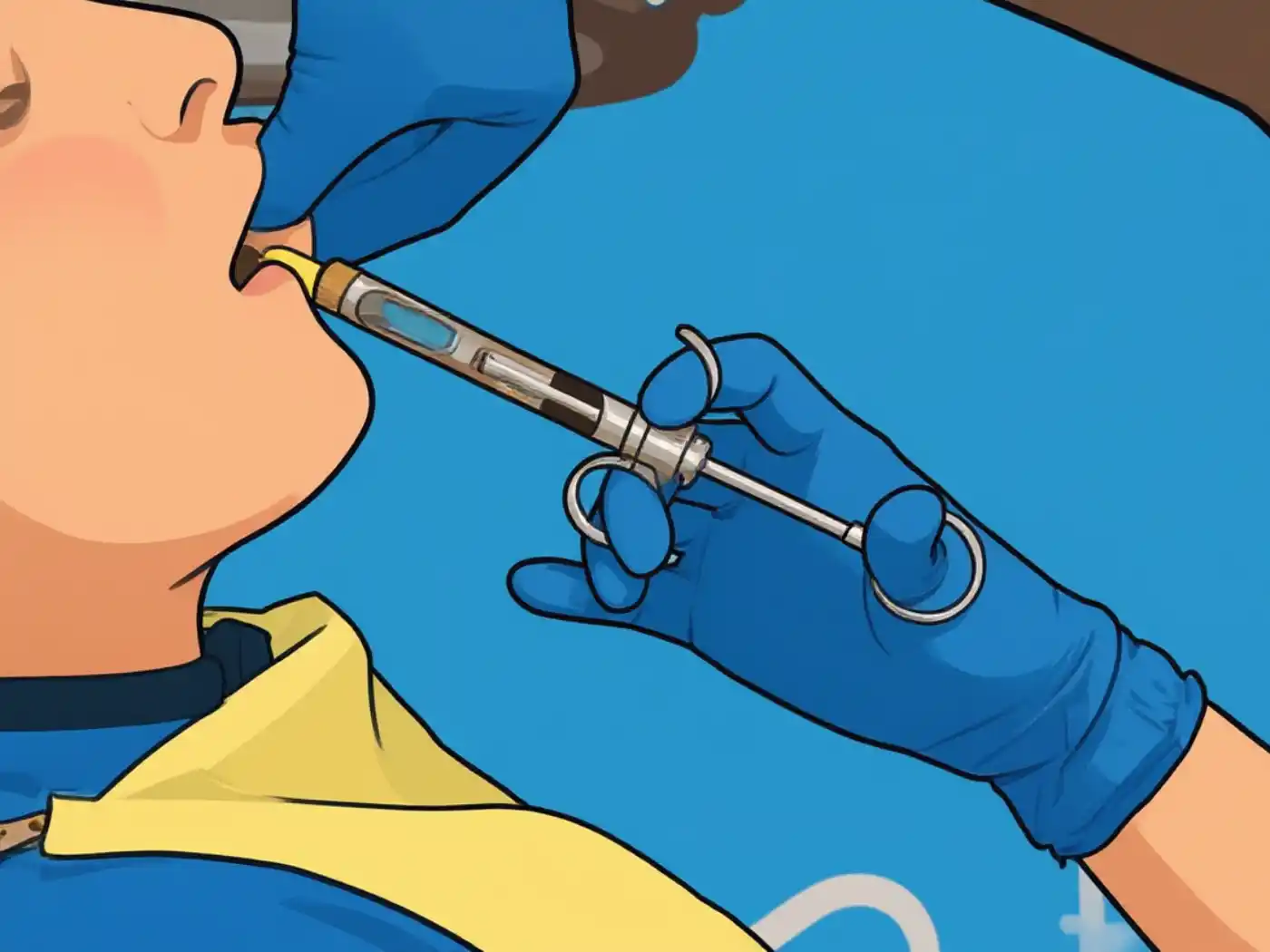
Everyone has a slightly different arrangement of blood vessels in their face and jaw, and there is generally one path for applying injections safely.
For lower jaw injections, it’s a different neighborhood.
Numbing the lower teeth means working near the artery and vein that run alongside the nerve supplying lower tooth sensation. [2] One study found that during this specific injection, pulling back on the syringe before injecting — a routine safety check called aspiration — showed blood almost 6% of the time, meaning the needle tip was sitting inside a vessel that often. [2]
None of this means the technique was sloppy. It means the anatomy in that specific spot is genuinely variable from person to person, and a vessel that sits in a “textbook” position in one patient can be a few millimeters off in the next. [1,2]
Two different problems get called “bruising” here, and it helps to know which one you have:
- A true hematoma — blood actually pooling under the skin or mucosa from a punctured vessel. This is what most people mean by “bruise.” [1,3]
- Blanching — a sudden, temporary paleness rather than discoloration, caused by the numbing solution’s vessel-tightening ingredient briefly cutting off blood flow to a patch of skin. [5,6] It looks alarming but isn’t the same event as a bruise, and it behaves completely differently — more on that below.
This is also a good moment to flag something separate: an injection can injure a nerve instead of a vessel, producing numbness rather than discoloration — different structure, different symptom, different timeline. If that’s closer to what you’re dealing with, the numb lip after wisdom tooth removal guide covers that side of things. Same injection family, two entirely different complications.
How long it takes to heal — the color-change timeline 📅
If it’s a true hematoma (an actual bruise):
Expect the full color arc your skin does with any bruise, just localized to your cheek. It typically takes 7 to 14 days for the blood to be fully reabsorbed. [3] Along the way, the color shifts — starting red or purple, moving toward green and yellow as the blood breaks down. [3] That color change isn’t a bad sign. It’s the normal signature of healing happening on schedule.
If it’s blanching (the pale, not purple, version):
This resolves much faster — usually within 20 to 40 minutes, as the vessel-tightening effect of the anesthetic wears off. [6,7,8] Documented cases describe the pallor showing up within seconds of the injection, then fading out within 10 to 40 minutes without any treatment at all. [6,7]
How often either of these actually happens:
Genuinely uncommon. Adverse effects from dental anesthesia overall — everything from mild soreness to these vascular events — range from about 4.5% to 26% depending on the study, but hematomas specifically are reported far less often within that range. [3] Blanching specifically shows up in roughly 0.3% to 1.2% of cases in the studies that have looked for it. [4] You’re not the first person this has happened to, and you’re also not in the majority.
Bruise, or something more serious? 🚨
Most of the time, this is exactly what it looks like: a small vessel got nicked, blood pooled, and your body is doing what it does with any bruise. But this section deserves a real answer, not a one-liner, because there’s a genuine cluster of situations worth knowing how to spot.
Signs this is progressing normally:
- The area is discolored but not actively growing bigger by the hour
- Mild tenderness, similar to any bruise elsewhere on your body
- No difficulty breathing, swallowing, or opening your mouth
- Color is shifting through the expected stages over days, not staying static or worsening
Signs that need more than “watch and wait”:
- Visual disturbances — double vision or any vision changes that last beyond 30 to 60 minutes. This has been reported, rarely, when anesthetic reaches vessels feeding the eye area, and it warrants prompt evaluation rather than a wait-it-out approach. [8]
- A hematoma that keeps expanding rather than settling, especially if it starts affecting your airway or ability to swallow comfortably — this is a “go now,” not a “call tomorrow,” situation.
- Numbness or weakness that doesn’t resolve on its own, well past when the anesthetic itself should have worn off — this points toward nerve involvement rather than simple bruising, a different complication covered in the numb lip guide above.
- Signs of an allergic or systemic reaction — dizziness, heart palpitations, or visual changes appearing during or right after the injection can indicate the anesthetic reached the bloodstream directly rather than staying local. [3,9] This is uncommon but is exactly why your dentist watches you closely for a few minutes after injecting, not just before.
- Signs of infection days later — increasing pain, warmth, or pus rather than the bruise fading as expected. Rare, but it’s the one scenario where the standard “just wait” advice actually needs to change. [3]
If none of those apply and you’re just looking at a normal-feeling bruise slowly changing color over a week or two — that’s the expected course, not a reason for alarm.
What to actually do about it 🛠️
In the first hour:
- If a hematoma is visibly forming, apply gentle direct pressure to the outside of the cheek. Your dentist may do this for you right in the chair. [3]
- A cold compress for 10–15 minutes helps limit swelling and encourages the vessels to constrict. [3]
The simplest home method involves soaking a clean washcloth in cold water, wringing it out, and applying it for 10 to 15 minutes, 1 to 2 hours in between.
- If it’s blanching rather than true bruising, there’s genuinely nothing to do but wait it out — this resolves on its own as the medication wears off. [5,9]

Over the following days:
- Avoid vigorous rinsing, very hot foods, or strenuous exercise for the first 24 hours — anything that raises blood pressure in the area can extend the bleeding. [3]
- Let the color changes happen. Red to purple to green to yellow is the normal healing sequence, not a sign of anything going wrong. [3]
- If you’re on blood thinners — warfarin, a DOAC, or an antiplatelet medication — you’re statistically more likely to bruise, but studies specifically looking at anticoagulated patients still found the risk of a clinically significant hematoma stayed low with proper technique. [3] Don’t stop a prescribed blood thinner over this without talking to the prescribing doctor first.
There’s no product or supplement that meaningfully speeds this along faster than time and basic care. Ice, gentle pressure, and patience are the actual treatment. [3]
When to call your dentist 📞
Call promptly, rather than waiting it out, if:
- Vision changes last longer than 30 to 60 minutes [8]
- The bruised area keeps expanding instead of stabilizing, or starts affecting breathing or swallowing
- You develop dizziness, a racing heartbeat, or other whole-body symptoms during or shortly after the injection [3,9]
- Numbness in the area isn’t resolving on the timeline your dentist described, separate from the expected temporary anesthetic numbness
- Days later, the area looks like it’s getting worse instead of better — more pain, warmth, or drainage rather than the expected fading
Otherwise, this is a genuinely low-drama complication. It’s also part of why the skill of the person holding the needle matters more than patients tend to assume — a practitioner who understands this anatomy well reduces the odds of this happening in the first place, and — just as importantly — knows exactly what to do in the moment if it does.
Bottom line 🎯
A bruised cheek after a dental injection almost always means a small vessel — an artery or a vein sitting closer to the injection site than average — got nicked during a completely routine procedure. [1,2,3] It’s not a sign of a bad dentist or a botched appointment. It’s a known, well-documented, mostly cosmetic complication with an excellent overall outlook. [3]
True bruising fades over one to two weeks, cycling through the normal bruise colors. [3] Blanching fades in under an hour. [6,7,8] Either way, the default plan is ice, a little pressure, and patience — with a clear, short list of red flags that mean this stopped being a simple bruise and started being something worth an actual phone call.
Related Reads 🔗

Numb Lip After Wisdom Teeth? Here's What's Normal
No pain, no feeling — and that's the confusing part. Here's how long numbness should last after wisdom teeth, and when it's actually a problem.

How to Know If a Dentist Is Good: 10 Trustworthy Signs
Not sure if your dentist is any good? Here are 10 trustworthy signs that help patients choose the right dentist — and avoid the ones they shouldn’t trust.

Gum Turned White After a Dental Injection? What It Means
A pale white patch right after the needle isn't the same as a sore that shows up days later. Here's the difference — and when to actually worry.
Roof of Mouth Sore After a Dental Injection? Why It Hurts
Not every sore on the palate is a canker sore. Here's why palatal injections leave the roof of your mouth aching — and how long it should last.
Sources
- [1] Carter EF. The bucco-gingival branch of the posterior superior alveolar artery: a source of haematomata when injecting in the maxilla. *Australian Dental Journal*. 1983;28(4):197-201. DOI: 10.1111/j.1834-7819.1983.tb02951.x
- [2] Meyer FU. Complications of local dental anesthesia and anatomical causes. *Annals of Anatomy - Anatomischer Anzeiger*. 1999;181(1):105-106. DOI: 10.1016/s0940-9602(99)80110-1
- [3] Ho JPTF, van Riet TCT, Afrian Y, et al. Adverse effects following dental local anesthesia: a literature review. *Journal of Dental Anesthesia and Pain Medicine*. 2021;21(6):507. DOI: 10.17245/jdapm.2021.21.6.507
- [4] Brand H, Bekker W, Baart J. Complications of local anaesthesia. An observational study. *International Journal of Dental Hygiene*. 2009;7(4):270-272. DOI: 10.1111/j.1601-5037.2009.00372.x
- [5] Herd MK, Smith RJR, Brennan PA. Long buccal nerve block: a previously unreported complication. *Oral Surgery, Oral Medicine, Oral Pathology, Oral Radiology, and Endodontology*. 2011;112(2):e1-e3. DOI: 10.1016/j.tripleo.2011.03.019
- [6] Kumaresan R, Rajeev V, Karthikeyan P, Arunachalam R. An unusual complication after administrating an inferior alveolar nerve block – A case report. *Journal of Oral and Maxillofacial Surgery, Medicine, and Pathology*. 2018;30(2):151-153. DOI: 10.1016/j.ajoms.2017.10.006
- [7] Kang SH, Won YJ. Facial blanching after inferior alveolar nerve block anesthesia: an unusual complication. *Journal of Dental Anesthesia and Pain Medicine*. 2017;17(4):317. DOI: 10.17245/jdapm.2017.17.4.317
- [8] Uckan S, Cilasun U, Erkman O. Rare Ocular and Cutaneous Complication of Inferior Alveolar Nerve Block. *Journal of Oral and Maxillofacial Surgery*. 2006;64(4):719-721. DOI: 10.1016/j.joms.2005.12.018
- [9] McCormick RS, Adams JR. Blanching of facial skin after infiltration of local anaesthetic: an unusual complication of inadvertent intra-arterial injection. *British Journal of Oral and Maxillofacial Surgery*. 2016;54(9):1051-1052. DOI: 10.1016/j.bjoms.2016.02.010
FAQ: Bruised Cheek After a Dental Injection: Real Answers ❓
Can a dental injection actually cause a bruise?
What causes a hematoma after a dental injection?
Is it normal to bruise on the cheek after a tooth extraction or root canal?
What happens if the injection hits a blood vessel?
How long does bruising from a dental injection last?
How do you treat a bruise or hematoma after dental work?
Can your face swell after a dental injection, not just bruise?
Is this the same thing as nerve damage from an injection?
When should I actually call my dentist about it?
🦷 Part of our Adult Oral Health Guide
This article is part of our Adult Oral Health Guide, where we break down the most common dental problems and how to actually deal with them.
About the Author: DMD Alexander K.
Doctor of Dental Medicine with clinical experience treating adults and children. This site focuses on practical prevention, symptom education, and helping patients make informed decisions.
Learn more on the About page.