Can't Open Your Mouth After Dental Work or a Numbing Shot
Last Updated: October 31, 2026
🕒 14 min read

Written by DMD Alexander K.
Doctor of Dental Medicine, 10+ years of clinical experience, focused on preventive dentistry and patient education. Learn more on the About page.
Table of Contents
Two Fingers, Maybe, If You’re Generous 😬
You can’t fit more than two fingers in your mouth. Your dentist said “a little sore.” Technically accurate. Emotionally useless.
Here’s what’s actually happening: your jaw isn’t broken, locked, or possessed. What you have almost certainly has a name — trismus — and a predictable cause, which in practice narrows down to one of four things:
- a muscle that got tired holding your mouth open,
- a needle that passed a little too close to a chewing muscle,
- ordinary swelling after an extraction,
- or the one that actually changes the plan — an infection.
This article sorts you into the right one, tells you what’s normal while you wait, and draws the line clearly for when “waiting” stops being the right move.
🦷 This article is part of our Adult Oral Health Guide Adult Oral Health Guide, where we break down the most common dental problems and how to actually deal with them.
Related Reads 🔗
Bruised Cheek After a Dental Injection? What It Means
A dental injection isn't supposed to leave a bruise — but sometimes it does. Here's why, how long it lasts, and when it's actually a problem.

Numb Lip After Wisdom Teeth? Here's What's Normal
No pain, no feeling — and that's the confusing part. Here's how long numbness should last after wisdom teeth, and when it's actually a problem.
Face Swelled Up and Feels Like Bubble Wrap? Here's Why
That crackling feeling under your skin isn't a bruise or an allergy — it's air, and it happened during your dental work. Here's why, calmly.
Double Vision After a Dental Injection? Here's Why
Seeing double right after a numbing shot is rare, real, and not a stroke. Here's the actual reason — and how long it takes to clear up.
Short Answer 🚀
Usually a sore muscle, not a lock. The chewing muscles near the injection or surgery site got irritated — by the needle, by swelling, by sitting open for an hour — and they’re doing what muscles do when irritated: tightening up defensively. [1,4] It gets better over days, not worse. Most people are close to normal within one to two weeks. [2,3]
Two lines on when that stops applying, covered in full further down: fever with a jaw that’s getting more stuck instead of less, or trouble swallowing, breathing, or swallowing your own saliva — that’s not “sore muscle” anymore, and it’s covered in When to Stop Waiting below.
Test It First: How Stuck Is “Stuck”? 📏
Before diagnosing yourself off vibes, measure it. Normal maximum opening between your upper and lower front teeth is roughly 40 to 50 mm in an adult. [1] Anything clearly under that — especially under about 35 mm — qualifies as trismus in the clinical sense, not just “feels tight.” [1]
The three-finger test, the low-tech version: your index, middle, and ring finger stacked vertically should fit between your front teeth in a normal, unrestricted mouth. Can’t manage it? You’re restricted. Can barely manage one finger? That’s a meaningfully bigger deal, and worth measuring with an actual ruler rather than estimating.
There’s a real grading scale behind this, for what it’s worth: Grade I is a 1–33% reduction from normal opening, Grade II is 34–66%, Grade III is 67–100%. [1] You don’t need to self-diagnose your exact grade — but writing down your opening in millimeters each morning, and watching whether the number is climbing or shrinking, is genuinely one of the most useful things you can do here. The trend matters more than any single measurement.
The 4 Usual Suspects 🔍
You held it open for an hour
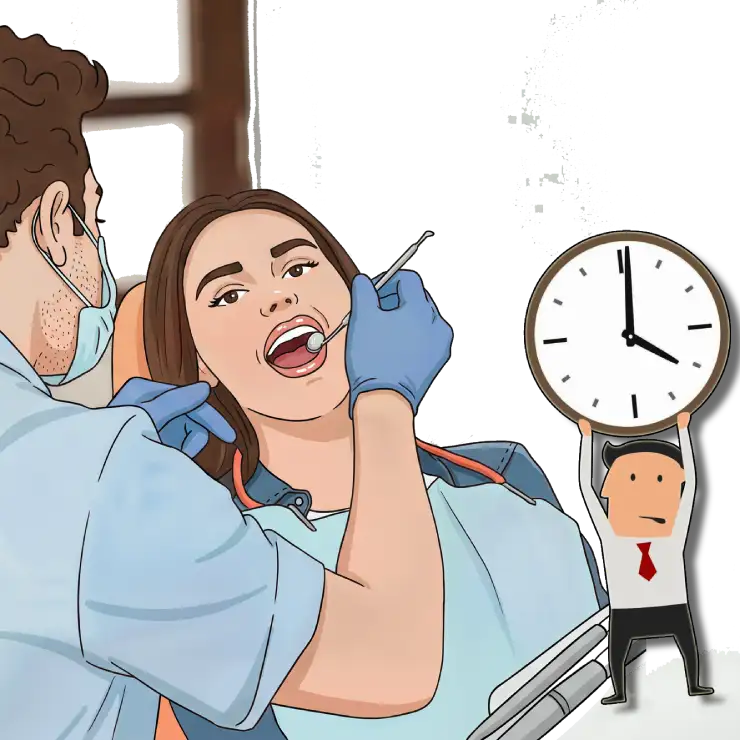
Dental appointments ask your jaw to do something it was never designed for: stay maximally open, unsupported, for twenty, forty, sometimes ninety minutes straight. That’s a genuine workout for muscles that normally only open and close briefly between bites. Soreness afterward is closer to a gym injury than a dental complication.
The rare but real escalation: holding the joint open that long, especially across multiple injections in one visit, can occasionally irritate the joint capsule itself rather than just the muscle — producing a slower, stranger kind of stiffness that doesn’t follow the usual few-days-and-done pattern. [9] This is uncommon. It’s mentioned here so you recognize it if your timeline looks genuinely odd, not because it’s the likely outcome.
The needle went through a chewing muscle (lower-jaw block)
This is the injection-specific cause, and it’s the one most people assume means something went wrong.
It usually doesn’t.
The anesthetic for lower back teeth has to pass close to two major chewing muscles —
the medial pterygoid and temporalis — on its way to the nerve it’s actually targeting. [4,5] Even a
technically perfect injection can leave a small amount of solution or a trace of bleeding sitting in
muscle tissue, and that muscle responds with soreness and protective tightening.
There’s also a direct pharmacological piece to this that has nothing to do with needle skill: local anesthetics are mildly toxic to muscle tissue at the concentrations used clinically. A large review of the evidence found this produces a predictable pattern — inflammation within days, some muscle breakdown in the first week, recovery over roughly two to four weeks — and, notably, this happens regardless of needle gauge, meaning it’s the drug’s effect on the tissue, not purely “the needle hit something.” [4] That’s a real, if slightly annoying, explanation for why a jaw can still be sore and weak two weeks after an injection that felt completely unremarkable at the time.
A less common variant worth knowing: if the needle nicks a small vessel, a contained pocket of blood can form in the same muscle space, tighten things further as it organizes, and — in documented cases — produce slowly worsening stiffness over about five days, sometimes followed by numbness of the lip or chin as it resolves. [5] That specific combination — stiffness building for several days, then numbness showing up as the stiffness starts easing — is worth mentioning to your dentist by name rather than filing under “normal soreness.”
Swelling after an extraction or surgery
The more tissue handling a procedure involves, the more trismus you should expect — this correlates directly with how difficult the extraction actually was. [1] Lower wisdom teeth, unsurprisingly, cause the majority of post-extraction cases, and age, medical history, and how close the tooth sat to the nerve canal all nudge the risk up further. [1,8] In a large study tracking people after wisdom tooth removal, 71% reported significant trouble opening on day one, dropping to 43% by day three, 22% by day five, and 11% by day seven. [2] This is the baseline “normal” against which everything else in this article gets compared.
Infection — which you don’t wait out
This is the one that behaves differently, and the difference is the entire point. Infection-related trismus shows up later than the other three, typically several days in rather than immediately, and it worsens instead of gradually improving. [6] It comes with company: fever, a general feeling of being unwell, and sometimes swelling you can see inside your mouth — along the soft palate, with the little dangling bit at the back of your throat (the uvula) pushed visibly off-center. [6]
Two documented cases make the point bluntly. One patient developed an opening of just 2mm along with soft palate swelling, uvula deviation, fever, and an elevated white count after a routine filling — requiring hospital admission, surgical drainage, and over a week of inpatient care. [6] Another developed a deep facial infection after what looked like a completely unremarkable upper wisdom tooth extraction — temperature of 39.5°C, opening under 10mm, and, critically, a completely normal-looking standard dental X-ray. The infection was only found with ultrasound and MRI. [6] The lesson from both: external swelling can look minor, or even absent, while a serious collection sits deeper than a regular X-ray can see. If something about your case looks infection-shaped, don’t let a clean-looking X-ray talk you out of getting imaged properly.
Which One Do You Have? ⏱️
Held open too long: onset same-day, ache more than sharp pain, minimal to no swelling, no fever, improves within a few days.
Needle-related muscle irritation: onset hours to 1–2 days after the injection, soreness with movement, little to no visible swelling, no fever, improves over 1–2 weeks. Watch for numbness showing up as the stiffness improves — that specific pairing is worth a mention to your dentist. [5]
Post-extraction swelling: onset day 0–1, peaks around day 2–3, visible local swelling, no fever (mild warmth is normal, true fever isn’t), steady improvement from day 3 onward. [2]
Infection: onset day 3 or later, progressively worsening rather than improving, real fever, visible intraoral swelling or uvula deviation, sometimes trouble swallowing. This is the pattern that moves you to the next section, not the waiting room.
One further pattern worth a single mention: jaw stiffness that doesn’t track any of the above — painless, patterned, repetitive movements, worse with talking or chewing, sometimes better when you touch your lips or bite on something — can occasionally be a muscle-control issue rather than swelling or injury at all, triggered by the same altered sensation dental work temporarily creates. [10,11] Genuinely uncommon, and frequently mistaken for ordinary jaw stiffness when it happens — mentioned here so it’s on your radar if nothing else on this page quite fits.
What’s Normal, Day by Day ⏳
Day 0–2: Worst point for most people. Significant restriction, some ache, possibly visible swelling if an extraction was involved. This is expected, not alarming. [2]
Days 3–7: Steady improvement should be underway. By day three, roughly half of post-extraction patients still report real trouble opening — but “still some trouble” and “unchanged or worse” are different things, and the direction matters more than the day number. [2]
Week 2: Most people are close to their normal opening by now. [2,3] Lingering mild stiffness, especially after a harder extraction or an injection-related muscle reaction, isn’t unusual.
Week 3 and later: This is where “still healing” should have become “basically fine.” Meaningful restriction still present at this point is the signal to stop assuming it’ll resolve on its own and get it actually looked at. [6]
What Helps, and What Makes It Worse 🛠️
What helps:
- Gentle stretching, done often rather than once dramatically — short sessions of opening and closing, plus side-to-side movement, several times a day. Movement encourages healing tissue to stay flexible instead of tightening into a stiffer, more stubborn pattern.
- Cold first, then warm — cold in the first day or two to calm acute swelling, switching to warm, moist heat afterward to help the muscle relax and loosen.
- Soft food for the first several days. Your jaw doesn’t need a steak-cutting challenge on top of everything else it’s dealing with.
- Over-the-counter pain relief, used exactly as the label directs — and if you’re already taking other medications or have a health condition that makes you unsure, that’s a genuine “ask your pharmacist” situation, not a guess-and-hope one.
What makes it worse:
- Forcing it open. Prying your own jaw wider than it wants to go, especially early on, risks turning simple soreness into a longer, more complicated recovery.
- Chewing gum to “work it out.” It feels productive. It isn’t, particularly in the first few days, and it can irritate tissue that’s already inflamed. Stick to the gentler, controlled stretching above instead.
- Waiting silently through a pattern that’s actually getting worse. Day-to-day soreness that slowly improves is normal. Day-to-day soreness that’s climbing is not something to just sit with.
When to Stop Waiting 🚨
Most of this resolves with time and patience. Get seen promptly — same day, not “next available” — if you have any of:
- Fever, especially alongside a jaw that’s getting more restricted rather than less. [6]
- Swelling spreading to your cheek, under your jaw, your neck, or around your eye — rather than staying localized to the surgical or injection site.
- Pus, a foul taste, or a bad smell that wasn’t there in the first day or two.
- Trouble swallowing, drooling, a muffled voice, or any difficulty breathing — this combination specifically points toward a deeper infection and is a go-now situation, not a call-tomorrow one. [6]
- Worsening after day 3, rather than the gradual improvement that’s supposed to be underway by then.
- No real improvement after about a week, even without fever or spreading swelling — that’s still worth an actual look rather than more waiting. [2,3]
- New numbness of the lip, chin, or tongue showing up alongside the stiffness — a specific, worth- mentioning-by-name combination, not something to treat as two unrelated issues. [5,6] If lingering numbness is actually your main symptom rather than stiffness, the numb lip after wisdom tooth removal guide is the more direct read.
One technical note worth knowing: if infection is even a real possibility, steroids shouldn’t be given until infection is ruled out — they can mask and worsen exactly the kind of deep infection described above. [6] If a steroid gets mentioned before anyone’s confirmed infection isn’t present, it’s fair to ask the question directly.
What Your Dentist Can Actually Do ⚕️
A proper visit for this isn’t complicated. Expect your dentist to:
- Measure your actual opening, not just ask how it feels — a number in millimeters, tracked against what’s expected for your timeline. [1]
- Check for infection specifically — looking at the soft palate, feeling for swelling your tongue can’t find on its own, and ordering imaging beyond a standard X-ray if anything about the picture doesn’t add up, since a normal-looking X-ray doesn’t rule out a deeper collection. [6]
- Prescribe something appropriate if the picture calls for it — this might mean a steroid injection directly into the area for stubborn swelling, or antibiotics if infection is confirmed. Either way, exactly what and how much is a conversation with your actual dentist, not a number from an article.
- Refer you onward if this needs more than a routine office visit — oral surgery for a suspected deep infection, or specialist follow-up if things genuinely aren’t tracking the expected recovery curve.
Next Time 🔁
If this has happened to you before, or happens now, it’s worth a short conversation at your next appointment rather than silently hoping it goes better by luck:
- Tell them it happened last time. This changes how an injection or a long procedure gets planned.
- Ask for breaks during longer appointments — a minute or two to close and rest the jaw periodically genuinely reduces strain on a joint that wasn’t built for extended holding.
- Ask about technique. Longer needles for certain blocks, avoiding repeated injections in the same short window, and slower injection technique are all real, documented ways this risk gets reduced — a dentist who takes the question seriously is worth noticing. [7]
Bottom Line 🎯
A jaw that won’t open after a numbing shot or a dental procedure is, in the overwhelming majority of cases, an irritated muscle doing exactly what irritated muscles do — not a lock, not nerve damage, and not a sign anyone did anything wrong. [1,2,3,4] It peaks early, improves steadily, and is usually close to normal within two weeks.
What actually changes the plan isn’t the stiffness itself — it’s the pattern around it. Fever, spreading swelling, trouble swallowing or breathing, or a trend that’s worsening instead of improving: that’s the signal to stop waiting and get seen. Everything else is gentle movement, cold then heat, soft food, and the patience to let an overworked muscle do what muscles do — recover, on its own schedule, if you let it.
Sources
- [1] Pathak S. Grading of extraction and its relationship with post-operative pain and trismus, along with proposed grading for trismus. *Journal of Clinical and Diagnostic Research*. 2014. DOI: 10.7860/jcdr/2014/8560.4470
- [2] White RP Jr, Shugars DA, Shafer DM, Laskin DM, Buckley MJ, Phillips C. Recovery after third molar surgery: clinical and health-related quality of life outcomes. *Journal of Oral and Maxillofacial Surgery*. 2003;61(5):535-544. DOI: 10.1053/joms.2003.50106
- [3] Harn SD, Durham TM. Incidence of lingual nerve trauma and postinjection complications in conventional mandibular block anesthesia. *The Journal of the American Dental Association*. 1990;121(4):519-523. DOI: 10.14219/jada.archive.1990.0198
- [4] Hussain N, McCartney CJL, Neal JM, Chippor J, Banfield L, Abdallah FW. Local anaesthetic-induced myotoxicity in regional anaesthesia: a systematic review and empirical analysis. *British Journal of Anaesthesia*. 2018;121(4):822-841. DOI: 10.1016/j.bja.2018.05.076
- [5] Smyth J, Marley J. An unusual delayed complication of inferior alveolar nerve block. *British Journal of Oral and Maxillofacial Surgery*. 2010;48(1):51-52. DOI: 10.1016/j.bjoms.2009.02.005
- [6] Gallagher J, Marley J. Infratemporal and submasseteric infection following extraction of a non-infected maxillary third molar. *British Dental Journal*. 2003;194(6):307-309. DOI: 10.1038/sj.bdj.4809941
- [7] Bailey E, Rao J, Saksena A. Case report: fractured needle in the pterygomandibular space following administration of an inferior dental nerve block. *Dental Update*. 2015;42(3):270-272. DOI: 10.12968/denu.2015.42.3.270
- [8] Bui CH, Seldin EB, Dodson TB. Types, frequencies, and risk factors for complications after third molar extraction. *Journal of Oral and Maxillofacial Surgery*. 2003;61(12):1379-1389. DOI: 10.1016/j.joms.2003.04.001
- [9] St-Hilaire H, Weber WD, Ramer M, Lumerman H. Clinicopathologic conference: trismus following dental treatment. *Oral Surgery, Oral Medicine, Oral Pathology, Oral Radiology, and Endodontology*. 2004;98(3):261-266. DOI: 10.1016/j.tripleo.2004.02.058
- [10] Jang SM, Cho YC, Sung IY, Kim SY, Son JH. Oromandibular dystonia after dental treatments: a report of two cases. *Journal of the Korean Association of Oral and Maxillofacial Surgeons*. 2012;38(6):379. DOI: 10.5125/jkaoms.2012.38.6.379
- [11] Britton D, Alty JE, Mannion CJ. Oromandibular dystonia: a diagnosis not to miss. *British Journal of Oral and Maxillofacial Surgery*. 2020;58(5):520-524. DOI: 10.1016/j.bjoms.2020.02.018
- [12] Baliga M, Dani MT. Efficacy of a plastic clothes peg in the management of trismus. *British Journal of Oral and Maxillofacial Surgery*. 2019;57(10):1166-1167. DOI: 10.1016/j.bjoms.2019.08.015
- [13] Mojsa IM, Pokrowiecki R, Lipczynski K, Czerwonka D, Szczeklik K, Zaleska M. Effect of submucosal dexamethasone injection on postoperative pain, oedema, and trismus following mandibular third molar surgery: a prospective, randomized, double-blind clinical trial. *International Journal of Oral and Maxillofacial Surgery*. 2017;46(4):524-530. DOI: 10.1016/j.ijom.2016.11.006
- [14] Moraschini V, Hidalgo R, Porto Barboza E dS. Effect of submucosal injection of dexamethasone after third molar surgery: a meta-analysis of randomized controlled trials. *International Journal of Oral and Maxillofacial Surgery*. 2016;45(2):232-240. DOI: 10.1016/j.ijom.2015.09.008
FAQ: Can’t Open Mouth After Dental Work Real Answers❓
How long until my mouth opens fully again?
Is it normal to still feel stiff or sore days after a dental injection?
Why does my jaw still hurt 2 weeks after a novocaine shot?
Is it normal after wisdom tooth removal?
Is this lockjaw? Could it be tetanus?
What happens if the dentist hit a nerve?
Heat or ice?
Do I need the ER?
About the Author: DMD Alexander K.
Doctor of Dental Medicine with clinical experience treating adults and children. This site focuses on practical prevention, symptom education, and helping patients make informed decisions.
Learn more on the About page.