Gum Turned White After a Dental Injection? What It Means
Last Updated: July 16, 2026
🕒 11 min read

Written by DMD Alexander K.
Doctor of Dental Medicine, 10+ years of clinical experience, focused on preventive dentistry and patient education. Learn more on the About page.

Table of Contents
Wait, why did my gum turn white? 💉
You got numbed. Ninety seconds later you glanced in the mirror rinsing your mouth out and saw it — a patch of gum, or maybe the skin near your lip, gone pale. Not swollen. Not bleeding. Just… bleached, like someone hit that one square with an eraser.
Your brain, unhelpfully, jumps straight to “necrosis,” “nerve death,” or whatever WebMD wants to sell you today.
Relax. This is called blanching, and it’s about as dramatic as a car alarm going off because a leaf landed on it. [1] It happens fast, it looks alarming, and it’s gone before your numbness even wears off half the time. [1,3,4]
🦷 Part of our Adult Oral Health Guide
This article is part of our Adult Oral Health Guide, where we break down the most common dental problems and how to actually deal with them.
What’s actually happening (blanching — a blood vessel thing, not a tissue thing) 🔬
Here’s the part nobody explains chairside, because most dentists are busy and most patients are too busy chewing on gauze to ask.
The local anesthetic they used almost certainly has epinephrine in it — a vasoconstrictor, meaning “a thing that squeezes blood vessels shut.” That’s not a side effect. That’s the design. It keeps the numbing agent local, makes it last longer, and helps control bleeding. [8,11] Useful drug. Occasionally overachieves.
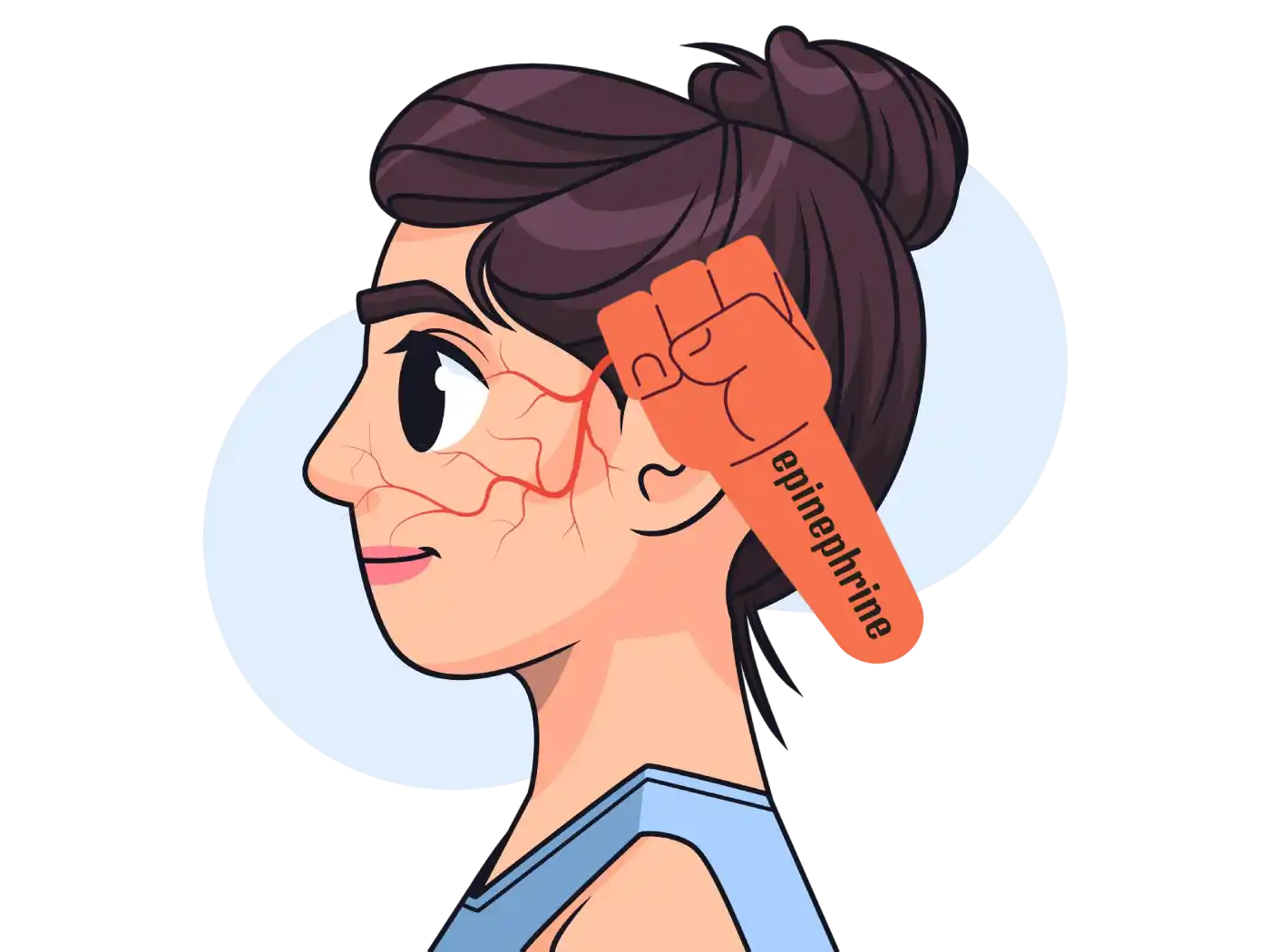
Artery path of the upper jaw, and each branch supplying certain part of the face. The epinephrine in the anesthetic can travel through these branches and cause blanching in the areas they supply.
There are two roads that lead to the same pale patch.
Road one: the needle found a vessel it wasn’t supposed to.
The face has a small artery, the maxillary artery, that loops in a genuinely inconvenient spot near the lower jaw injection site
in about 88% of people — sometimes coming within 4 millimeters of the exact place a needle is aimed. [4]
Hit it, and the epinephrine gets a free ride backward into the artery,
then forward again into its branches — the ones feeding your cheek ,
lower eyelid, nose, upper lip, and palate . [4,9]
Everywhere that blood normally goes, the vessels clamp down instead, and the tissue loses its color because,
well, it’s temporarily lost most of its blood supply.
Road two: the needle didn’t hit anything, and it still happened.
This one’s stranger and, frankly, more interesting.
Some researchers found that blanching can occur even when the syringe was pulled back first and showed no blood —
meaning no vessel was actually punctured. [5]
Their theory: the needle physically irritated the nerve fibers wrapped around nearby arteries,
triggering a reflex that made those vessels clamp down anyway, like a spooked cat. [5]
Nobody has to be inside the vessel for the vessel to overreact.
Sometime it can cause a sore too:
There’s also a simpler, boring explanation for smaller patches, particularly on the roof of the mouth: the tissue there is thin and glued tightly to bone, so the anesthetic has nowhere to spread. It just sits there, constricting locally, and you get a small white spot right at the injection site. [3]
None of these involve your dentist doing anything wrong. One study specifically measured this — epinephrine-containing anesthetics shrink blood vessel diameter by roughly 35% in soft tissue. [7] That’s the drug working as intended, just in a spot with enough blood vessel real estate to make it visible.
If you’re trying to figure out which injection-related surprise you actually have:
Numbness that lingers, tingling, or a lip that feels like it belongs to someone else — that’s nerve territory, not vessel territory, and it’s covered separately in the numb lip after wisdom tooth removal guide . A purple or dark bruise that shows up and slowly changes color over days — that’s a punctured vessel bleeding into tissue, a different event entirely, walked through in the bruised cheek guide . This article is about the third option: pale, not purple. Blanched, not bruised. Same five minutes in the chair, three completely different souvenirs.
How long it takes to fade back to normal 📅
Fast. This is the good news section, so don’t skip it looking for a catch.
Blanching typically shows up within seconds to two minutes of the injection. [2,4] It resolves — fully, on its own, no treatment required — within 10 to 40 minutes in the large majority of documented cases. [1,3,4] Some case reports describe the color returning in as little as 15–20 minutes. [8]
It’s genuinely uncommon in the first place. Older studies put the incidence at roughly 0.3% to 1.2% of injections. [1] One study that specifically watched for it across 103 mandibular block injections found zero cases. [11] Researchers suspect it’s underreported precisely because it resolves so quickly that if nobody’s looking right after the injection, nobody sees it happen. [9]
So: this isn’t a slow bruise you’ll be tracking through a rainbow of colors over two weeks. If it’s blanching, it’s largely a non-event by the time you’re back in the waiting room signing a checkout form.
Is this a canker sore instead? Here’s how to tell 🔍
This is the section that actually matters, so read it before you convince yourself of the wrong diagnosis at 1 a.m.
“White thing in my mouth after the dentist” is genuinely ambiguous without a timeline, and blanching is not the only white thing a needle can produce. A needle stick is, technically, minor trauma — and minor oral trauma is a classic trigger for a canker sore . Two entirely different mechanisms, two entirely different experiences, and confusing them means either panicking over nothing or ignoring something that actually wants a week of your patience.
Three axes tell them apart. Check all three, not just one.
Timing:
- Blanching shows up almost immediately — seconds to a couple of minutes after the needle.
- A canker sore doesn’t show up on day one. It typically appears a day or two later, once the trauma has had time to trigger the ulcer.
Pain:
- Blanching is usually painless, or accompanied at most by a brief sharp twinge right as it appears, and sometimes a sensation of pressure. [2,4] The area itself doesn’t hurt to touch once numbness fades.
- A canker sore hurts. That’s basically its entire personality. Touch it, eat something acidic near it, and it lets you know immediately.
Appearance:
- Blanching is a uniform pale or white patch with no distinct border, no redness around it, no raised edge. It looks like a spotlight was aimed at that patch of tissue.
- A canker sore has a distinct red, inflamed border ringing a white or yellowish center — a small crater, not a flat pale patch.
Duration:
- Blanching: gone in under an hour.
- Canker sore: sticks around for 7 to 10 days, following its own slow healing arc regardless of how much you want it gone by Tuesday.
If what you’re actually looking at showed up a day or two after your appointment, hurts when you touch it, and has that little red rim around a pale center — that’s not blanching anymore. That’s a garden-variety canker sore, coincidentally triggered by getting jabbed with a needle, and it deserves its own read rather than this one: how to get rid of canker sores fast .
What to actually do about it 🛠️
If it’s genuinely blanching — pale, immediate, painless:

- Nothing. That’s not laziness, that’s the actual medical consensus. [2,4] It resolves on its own.
- Your dentist may pause the injection briefly if they notice it happening in real time, mostly out of professional caution, not because there’s an emergency unfolding. [4,9]
- The appointment itself usually just continues once the color starts coming back and you’re comfortable. [2,4]
If it’s turning out to be a canker sore instead:
- Salt water rinses, avoiding acidic or spicy food near it, and basic patience are your actual tools here — the ulcer runs its own clock regardless of what you throw at it.
- The canker sores guide has the fuller playbook if this is the one you’re dealing with.
Either way:
- Don’t poke at it, don’t scrub it with a toothbrush trying to “fix” it, and don’t panic-Google yourself into believing you have tissue necrosis because one forum post used the word.
When it’s actually worth a call 📞
Most of the time, nobody needs to hear from you about this. Call anyway if:
- The white patch isn’t fading after roughly an hour — genuine blanching should be resolving by then, not still sitting there. [1,3,4]
- You notice vision changes — blurriness, double vision, drooping eyelid — which is rare, but has been reported when anesthetic makes an unlikely detour toward the eye’s blood supply. [1,9] This warrants prompt evaluation, not a wait-and-see approach.
- The pale area comes with swelling, hives, itching, or trouble breathing — that’s not blanching’s profile at all, and points toward a genuine allergic reaction instead, which is rare with modern dental anesthetics but real. [10,11]
- You feel your heart racing, palpitations, or lightheadedness during or right after the injection — a sign the epinephrine reached general circulation more than intended. [8,10]
- Days later, instead of a fading pale patch, you’re looking at something painful with a defined red border that’s settling in for the long haul — that’s the canker sore conversation, not this one.
Everything else — pale, fast, painless, gone before your lunch reservation — is exactly what blanching is supposed to do.
And for what it’s worth: injection technique and a solid working knowledge of exactly where these vessels like to hide genuinely reduces how often any of this happens in the first place. If you’ve ever wondered whether “just any dentist” is good enough, this is a decent argument for why it isn’t — the guide to finding a good dentist covers what separates competent from careless, and anatomy knowledge is very much on that list.
Bottom line 🎯
A gum or cheek turning white right after a dental injection is almost always blanching — blood vessels clamping down, briefly, either because the epinephrine got somewhere it wasn’t aimed or because a nearby nerve overreacted to the needle. [1,4,5] It’s uncommon, it’s fast, and it’s boring in the best possible way: it resolves in under 40 minutes with zero intervention required. [1,3,4]
What it isn’t: a canker sore, which shows up later, hurts, and has a red rim instead of a flat pale patch — a completely separate injury with its own week-long timeline.
The injection did something visible. Now you know which something. File it under “your body being briefly dramatic,” and get on with your day.
Related Reads 🔗
- Numb Lip After Wisdom Teeth? Here’s What’s Normal
- Bruised Cheek After a Dental Injection? What It Means
- How to Get Rid of Canker Sores Fast and Naturally
- How to Find a Good Dentist: 10 Trustworthy Signs
- Adult Oral Health — Full Topic Guide

Numb Lip After Wisdom Teeth? Here's What's Normal
No pain, no feeling — and that's the confusing part. Here's how long numbness should last after wisdom teeth, and when it's actually a problem.

Bruised Cheek After a Dental Injection? What It Means
A dental injection isn't supposed to leave a bruise — but sometimes it does. Here's why, how long it lasts, and when it's actually a problem.
How to Get Rid of Canker Sores Fast and Naturally
Find out effective ways to get rid of canker sores quickly with natural remedies that you can find in your household with expert dental advice.
Roof of Mouth Sore After a Dental Injection? Why It Hurts
Not every sore on the palate is a canker sore. Here's why palatal injections leave the roof of your mouth aching — and how long it should last.
Sources
- [1] Ho JPTF, van Riet TCT, Afrian Y, et al. Adverse effects following dental local anesthesia: a literature review. *Journal of Dental Anesthesia and Pain Medicine*. 2021;21(6):507. DOI: 10.17245/jdapm.2021.21.6.507
- [2] Kang SH, Won YJ. Facial blanching after inferior alveolar nerve block anesthesia: an unusual complication. *Journal of Dental Anesthesia and Pain Medicine*. 2017;17(4):317. DOI: 10.17245/jdapm.2017.17.4.317
- [3] McCormick RS, Adams JR. Blanching of facial skin after infiltration of local anaesthetic: an unusual complication of inadvertent intra-arterial injection. *British Journal of Oral and Maxillofacial Surgery*. 2016;54(9):1051-1052. DOI: 10.1016/j.bjoms.2016.02.010
- [4] Kumaresan R, Rajeev V, Karthikeyan P, Arunachalam R. An unusual complication after administrating an inferior alveolar nerve block – A case report. *Journal of Oral and Maxillofacial Surgery, Medicine, and Pathology*. 2018;30(2):151-153. DOI: 10.1016/j.ajoms.2017.10.006
- [5] Kronman JH, Giunta JL. Reflex vasoconstriction following dental injections. *Oral Surgery, Oral Medicine, Oral Pathology*. 1987;63(5):542-544. DOI: 10.1016/0030-4220(87)90224-6
- [6] Waterson JG. Vasoactivity of local anaesthetic solutions. *Australian Dental Journal*. 1976;21(1):30-34. DOI: 10.1111/j.1834-7819.1976.tb04414.x
- [7] Tanaka K, Kudo K, Ambe K, Kawaai H, Yamazaki S. A Histological Study of Vasoconstriction by Local Anesthetics in Mandible. *Anesthesia Progress*. 2018;65(4):244-248. DOI: 10.2344/anpr-65-03-15
- [8] Ogle OE, Mahjoubi G. Local Anesthesia: Agents, Techniques, and Complications. *Dental Clinics of North America*. 2012;56(1):133-148. DOI: 10.1016/j.cden.2011.08.003
- [9] Herd MK, Smith RJR, Brennan PA. Long buccal nerve block: a previously unreported complication. *Oral Surgery, Oral Medicine, Oral Pathology, Oral Radiology, and Endodontology*. 2011;112(2):e1-e3. DOI: 10.1016/j.tripleo.2011.03.019
- [10] Bahar E, Yoon H. Lidocaine: A Local Anesthetic, Its Adverse Effects and Management. *Medicina*. 2021;57(8):782. DOI: 10.3390/medicina57080782
- [11] Brand H, Bekker W, Baart J. Complications of local anaesthesia. An observational study. *International Journal of Dental Hygiene*. 2009;7(4):270-272. DOI: 10.1111/j.1601-5037.2009.00372.x
FAQ: White Patch on Gum After a Dental Injection: Real Answers ❓
Why did my gum turn white right after a dental injection?
Can a dental injection site get infected?
How long does it take for the white patch to fade?
Is a white patch on my gums after an injection contagious?
Does the white patch mean it's healing, or that something's wrong?
Is this the same thing as a canker sore?
What can go wrong with a dental injection, generally?
When should I actually be concerned?
🦷 Part of our Adult Oral Health Guide
This article is part of our Adult Oral Health Guide, where we break down the most common dental problems and how to actually deal with them.
About the Author: DMD Alexander K.
Doctor of Dental Medicine with clinical experience treating adults and children. This site focuses on practical prevention, symptom education, and helping patients make informed decisions.
Learn more on the About page.