Baby Tooth Turned Grey After a Fall? What It Means
Last Updated: July 9, 2026
🕒 11 min read

Written by DMD Alexander K.
Doctor of Dental Medicine, 10+ years of clinical experience, focused on preventive dentistry and patient education. Learn more on the About page.
Table of Contents
Don’t panic — a grey tooth isn’t an emergency room trip 🦷
Your toddler face-planted off the couch, the coffee table, the dog, whatever it was this week.
They cried for ninety seconds, ate a snack, and moved on like nothing happened.
You didn’t move on.
Because three days later, that front tooth is grey.
Not chipped. Not loose. Not hurting.
Just… grey. Like someone dimmed one tooth and left the rest alone.
Here’s the reassurance up front: this is one of the most common things that happens after a bump to a baby tooth, and it’s rarely the crisis it looks like. [3,6] A worldwide look at kids’ dental injuries put the rate of trauma to baby teeth at close to 1 in 5 children. [6] Grey discoloration afterward isn’t the rare complication — it’s practically the expected one.
So take the breath. Then keep reading, because “not an emergency” doesn’t mean “ignore it forever,” and the difference matters.
👶 Part of our Kids Dental Health Guide
This article is part of our Kids Dental Health Guide, where we break down the most common dental problems in children and how to actually deal with them.
What’s actually happening (the pulp/bruise mechanism) 🔬
Think of the grey tooth as a bruise you can’t see forming under skin — except the skin is enamel, and you’re watching it from the outside in.
Inside every tooth is a soft core called the pulp, packed with blood vessels and nerve tissue. A hard enough knock ruptures some of those vessels. Blood leaks into the pulp chamber. That’s the entire event. [1,3,4]
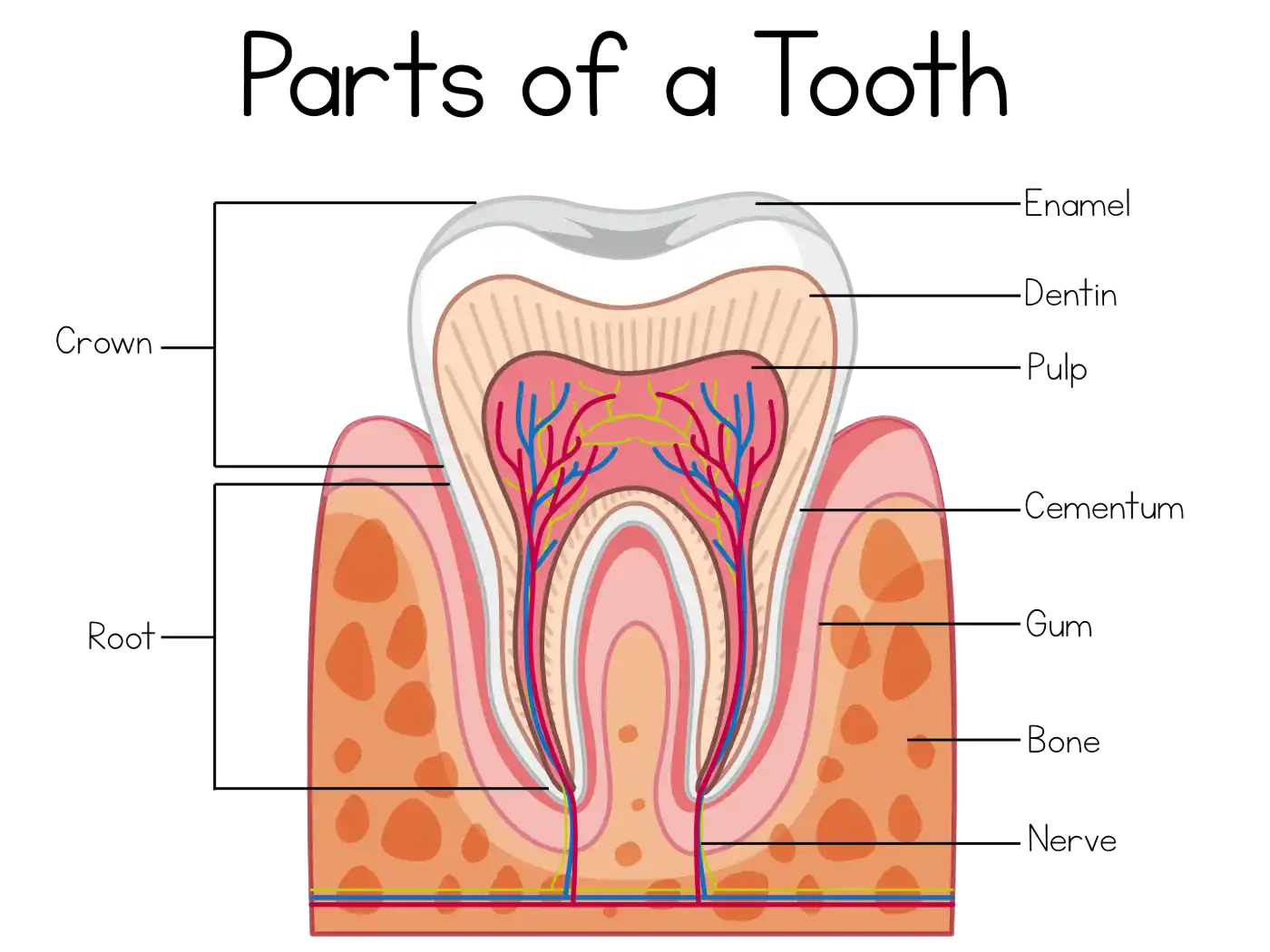
Notice a narrow entry point of blood vessels into the pulp chamber. Now imagine an impact on the tooth, here would be where the blood vessels rupture. That means the living tissue inside the tooth is bruised, and the color change you see is a bruise showing through the enamel.
What happens next is just biology doing what bruises do — breaking down blood, releasing pigment, changing what color shows through. The exact mechanism has been debated by researchers for a while: older theories held that blood breakdown products soak into the dentin itself and stain it from the inside. [1] Newer evidence suggests the color change may actually stay contained within the pulp chamber, with the crown just looking different because of what’s sitting behind it — same effect, more precise explanation. [4]
Either way, the tooth isn’t rotting. It’s bruised.
Which teeth this happens to, and when:
- Peak age for this kind of fall-related injury is 2–3 years old — exactly when kids are learning to run faster than their coordination can handle [3]
- The upper front teeth take the brunt of it almost every time [3,5]
- Even a mild injury — a tooth that just got jarred without visibly moving — can trigger this. You don’t need a dramatic fall for a dramatic color change. [2,5]
If you’re also dealing with a tooth that looks structurally strange rather than color-strange — like a second tooth erupting behind a baby tooth that hasn’t budged — that’s a different mechanism entirely, more about eruption timing than trauma. Worth reading separately: Shark Teeth Explained .
And if the concern started as a color question rather than a fall — dark spots that showed up with no injury attached — that’s almost certainly not this. Bacterial staining and trauma bruising look similar to a worried parent and nothing alike to a dentist: one is bacteria living at the gumline, the other is blood pigment inside the tooth after an impact. If that’s closer to what you’re seeing, the black spots guide is the right read instead of this one.
How long the discoloration takes to show up, and what it looks like 📅
The color doesn’t jump straight to grey. It has a sequence.
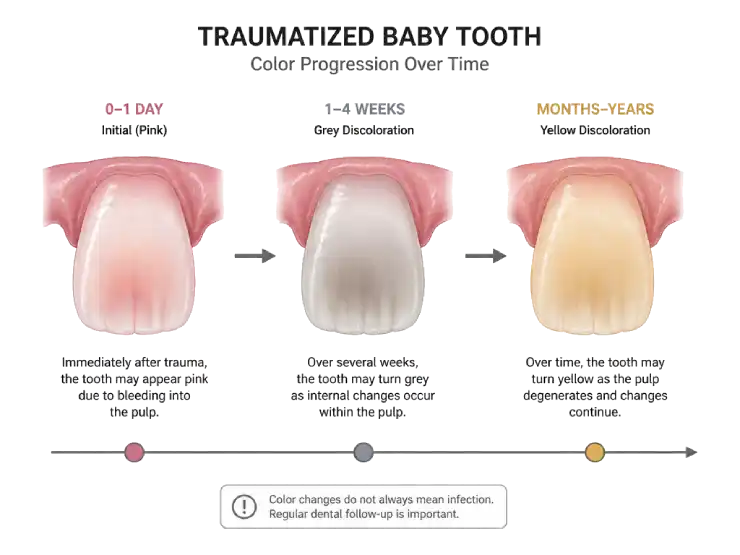
Days 1–3: A pink or pinkish-red tint often shows up first — that’s fresh blood in the pulp chamber, still close to its original color. [1]
Days 3 to a few weeks: The pink shifts toward grey as the blood breaks down. [1] This is usually the point where parents notice and panic, because pink at least looked like “still a tooth” and grey looks like “something’s wrong.”
Weeks to months out: One of three things happens. The tooth can recover something close to its normal shade. It can shift toward yellow — which, counterintuitively, is often good news. Or it can stay dark. [1,5,8]
A colorimeter study that measured this precisely found the tooth typically hits its darkest point around day 71 post-injury, then gradually lightens from there — though in a meaningful share of cases, it never fully returns to looking “normal” by eye. [1]
So: pink, then grey, darkest around the two-and-a-half month mark, then it either lightens, yellows, or settles into a permanent shade. That’s the timeline. There’s no version of this that happens overnight, and there’s no version where the color is final within the first week — which is exactly why “wait and watch” is the standard approach, not a cop-out.
Will it get better, or is it permanent? 🔮
This is the actual question, and the honest answer is: it depends on the pattern, not just the color.
Grey that fades — this is the good outcome.
Around 15% of injured teeth turn grey early and then fade, often toward yellow. [5] Of those fading teeth, the vast majority — about 78% — end up yellow, and about 72% develop something called pulp canal obliteration, which sounds ominous and isn’t. It means the pulp survived the injury and is laying down hard tissue as it heals. [5] Only a small fraction — roughly 3–4% — of these fading-grey teeth go on to actually die. [5]
Yellow discoloration — also a good sign, despite looking “worse” to a parent’s eye.
Yellow usually means that same healing process: pulp canal obliteration. [1,5] These teeth have a very low risk of complications — under 2% go on to develop real problems — and rarely need any treatment at all. [2,5]
Grey that stays grey — this is the one worth watching more closely.
About 18% of injured teeth land here: dark, and staying dark. [5] These carry a real, elevated risk — somewhere in the 44–66% range across different studies — of the pulp eventually dying. [2,5] But — and this is the part that gets lost in panic-Googling — more than half of persistently grey teeth never develop any infection at all, in some studies over 50%, tracked for years. [5,8]
Read that again: a tooth can stay grey forever and be perfectly fine.
In this case we are talking about sterile pulp necrosis,
which is a fancy way of saying the pulp is dead but not infected and that is good.
Grey is not, by itself, a diagnosis. It’s a color. What matters is whether anything else shows up alongside it.
When it’s actually a dental emergency 🚨
This is the section that actually earns your attention, so don’t skim it.
Color alone — even permanent, unchanging grey — is not an emergency and is not, by itself, a reason for root canal treatment or extraction. Major dental trauma guidelines are explicit about this: treatment isn’t indicated for discoloration alone unless there are signs the tooth is actually infected. [6]
Here’s what those actual signs look like — the difference between “cosmetically dark” and “something is wrong inside”:
- Swelling in the gum near the tooth, or anything that looks like an abscess
- A sinus tract — a small bump or pimple-like spot on the gum that can drain fluid
- Pus or discharge coming from around the gumline near that tooth
- The tooth becoming noticeably more mobile than it should be for its age and stage
- Your child reacting with pain when you gently tap the tooth, when there was no pain before
- On an X-ray your dentist takes, signs of bone changes or root resorption around the tooth [6,8]
Any of those — not color alone, but these — is your reason to get seen promptly rather than waiting for the next routine visit.
There’s also a separate, more urgent category that has nothing to do with the tooth’s color and everything to do with the head it’s attached to. After any fall hard enough to discolor a tooth, watch for dizziness, a headache that doesn’t resolve, vomiting, unusual sleepiness, or any loss of consciousness — those point toward a possible head injury, not a dental one, and need medical attention immediately, not a dental appointment. [3]
So: grey alone, no other symptoms — this is a “mention it at the next checkup” situation. Grey plus swelling, drainage, new mobility, or new pain — this is a “call now” situation. Dizziness or vomiting after the fall — this is an urgent care or ER situation, tonight, regardless of what the tooth looks like.
What to actually do right now 🛠️
In the first few days after the fall:
- Check your kid over generally — other injuries, bumps, cuts — not just the tooth
- Watch for the head-injury red flags above for the first 24–48 hours
- Get a dental evaluation within a few days, not necessarily that same hour, unless something above is present [3]
At the dental visit: Your dentist will look at the injury type, take a baseline X-ray for comparison later, and — importantly — will not rely on the tests used for adult teeth. Cold tests and electric pulp tests, the ones that check if a tooth is “alive,” are unreliable in baby teeth and generally skipped. [6] What actually matters here is watching the tooth over time, not a single test on day one.
Ongoing monitoring — this is the real treatment plan: Current international guidelines land firmly on active monitoring as the standard of care for a discolored-but-otherwise-quiet tooth: [6]
- Follow-up checkups roughly every 6–12 months
- X-rays taken as needed, not routinely, to keep radiation exposure minimal
- You, watching at home for the swelling/drainage/mobility signs above between visits
One study directly tested whether jumping straight to root canal treatment on a symptom-free grey tooth actually improves outcomes compared to just watching it. It didn’t. Early extraction rates, effects on the permanent tooth underneath, and enamel problems in the adult tooth were essentially the same either way. [7] Which is a fairly direct way of saying: treating a color, instead of a problem, doesn’t buy your kid anything.
One more thing worth knowing, honestly: severe injuries — particularly ones where the tooth got pushed up into the gum — carry some risk of affecting the permanent tooth developing underneath, especially in kids injured before age 3. This can show up years later as a spot or a groove on the adult tooth when it finally erupts. [3] It’s not something you can prevent after the fact. It’s something your dentist should mention so it’s not a surprise down the line, and it’s exactly the kind of detail that makes picking a dentist you actually trust worth the effort — the guide to finding a good dentist covers what that actually looks like.
Bottom line 🎯
A baby tooth turning grey after a fall is a bruise, not a rot. It’s common, it follows a predictable color timeline, and the color itself — even if it never fades — is not an automatic sign of trouble. [1,5,6]
What decides the outcome isn’t the shade. It’s whether swelling, drainage, new mobility, or new pain show up alongside it. No extra symptoms, no treatment needed — just watching. Extra symptoms, and it’s time to actually go in.
Baby teeth don’t get to skip protection just because they’re temporary. This one still has a job to do until it’s ready to leave on its own schedule.
Related Reads 🔗
- Black Spots on Baby Teeth: Cavity, Stain, or Fine?
- Tooth Growing in Behind Baby Tooth? Shark Teeth Explained
- How to Find a Good Dentist: 10 Trustworthy Signs
- Kids Dental Health — Full Topic Guide

Black Spots on Baby Teeth: Cavity, Stain, or Fine?
Black dots on your kid's teeth aren't always decay. Sometimes it's bacteria, sometimes it's iron, sometimes it's nothing. Here's how to tell which.

Tooth Growing in Behind Baby Tooth? Shark Teeth Explained
Two rows of teeth out of nowhere isn't a crisis. Dentists call it shark teeth. Here's what's actually happening — and when it's worth a call.

Baby Teething Chart by Age: Interactive Timeline + 101 Guide
See when baby teeth come in with our interactive teething chart. Select your child’s age and explore eruption timelines and tooth replacement.
Baby Tooth Looks Like Two Teeth Joined Together? Why
One oversized tooth where there should be two isn't a mistake in nature. Dentists call it a fused tooth. Here's what it means, calmly.
Sources
- [1] Hyun H, Shin TJ, Kim Y. The post-traumatic colour change of primary incisors: a colourimetric and longitudinal study. *International Journal of Paediatric Dentistry*. 2015;26(4):291-300. DOI: 10.1111/ipd.12199
- [2] Goettems ML, Thurow LB, Noronha TG, et al. Incidence and prognosis of crown discoloration in traumatized primary teeth: A retrospective cohort study. *Dental Traumatology*. 2020;36(4):393-399. DOI: 10.1111/edt.12552
- [3] McTigue DJ. Overview of Trauma Management for Primary and Young Permanent Teeth. *Dental Clinics of North America*. 2013;57(1):39-57. DOI: 10.1016/j.cden.2012.09.005
- [4] Holan G. Pulp aspects of traumatic dental injuries in primary incisors: Dark coronal discoloration. *Dental Traumatology*. 2019;35(6):309-311. DOI: 10.1111/edt.12483
- [5] Boorum MK, Andreasen JO. Sequelae of trauma to primary maxillary incisors. I. Complications in the primary dentition. *Dental Traumatology*. 1998;14(1):31-44. DOI: 10.1111/j.1600-9657.1998.tb00806.x
- [6] Day PF, Flores MT, O'Connell AC, et al. International Association of Dental Traumatology guidelines for the management of traumatic dental injuries: 3. Injuries in the primary dentition. *Dental Traumatology*. 2020;36(4):343-359. DOI: 10.1111/edt.12576
- [7] Holan G. Long-term effect of different treatment modalities for traumatized primary incisors presenting dark coronal discoloration with no other signs of injury. *Dental Traumatology*. 2006;22(1):14-17. DOI: 10.1111/j.1600-9657.2006.00346.x
- [8] Holan G. Development of clinical and radiographic signs associated with dark discolored primary incisors following traumatic injuries: a prospective controlled study. *Dental Traumatology*. 2004;20(5):276-287. DOI: 10.1111/j.1600-9657.2004.00285.x
FAQ: Grey Baby Tooth After a Fall: Real Answers ❓
Why did my child's tooth turn grey after a fall?
How long does it take for a tooth to turn grey after an injury?
Can a grey baby tooth recover on its own?
Is a grey tooth painful for a toddler?
Is a grey tooth a dental emergency?
Does a grey baby tooth need to be pulled?
What does a bruised baby tooth look like?
How can I tell if the tooth is healing or dying?
Does the discoloration ever go away completely?
👶 Part of our Kids Dental Health Guide
This article is part of our Kids Dental Health Guide, where we break down the most common dental problems in children and how to actually deal with them.
About the Author: DMD Alexander K.
Doctor of Dental Medicine with clinical experience treating adults and children. This site focuses on practical prevention, symptom education, and helping patients make informed decisions.
Learn more on the About page.