Black Spots on Baby Teeth:
Cavity, Stain, or Fine?
Last Updated: July 1, 2026
🕒 9 min read

Written by DMD Alexander K.
Doctor of Dental Medicine, 10+ years of clinical experience, focused on preventive dentistry and patient education. Learn more on the About page.

Table of Contents
The short answer 🦷
You looked in your toddler’s mouth.
You saw black dots along the gumline.
You closed three browser tabs of increasingly worse search results and opened this one instead.
Good instinct.
Most black spots on baby teeth are not cavities.
They’re something dentists call black stain —
a surface discoloration caused by a specific type of bacteria that likes to set up shop right at the gumline. [1,2]
It’s not decay.
It’s not poor hygiene.
It won’t hurt the tooth.
And here’s the part that annoys every parent who’s spent a year feeling guilty about snacks: kids with black stain tend to get fewer cavities than kids without it. [2,6]
Yes, really.
We’ll get to why.
👶 Part of our Kids Dental Health Guide
This article is part of our Kids Dental Health Guide, where we break down the most common dental problems in children and how to actually deal with them.
What’s actually causing the black spots 🔬
Black stain is, technically, just plaque.
A weird, specific, dark-colored kind of plaque — but plaque.
Don’t mistake it if the whole tooth turned suddenly gray — that’s a different issue. Check out the gray tooth article if you suspect that.
It shows up as a dark line or a row of little dots hugging the cervical third of the tooth — the part closest to the gum. [1,2] Sometimes it spreads into a diffuse patch. Sometimes it shows up on the back surfaces where you’d never spot it without a flashlight and a fight. [3] It usually starts as early as age 2, and it can stick around into the permanent teeth too. [3,4]
The prevalence swings wildly by country — anywhere from about 2.4% to 18% of kids, depending on where the study was done. [2,5] Spain sees it in about 3% of six-year-olds. India reports it in nearly one in five. [2,5] Nobody fully agrees why the geography matters this much, which is dentistry’s polite way of saying “we have theories.”
What’s actually making it black:
Specific bacteria — mostly Actinomyces species — colonize that gumline plaque. [1,2,9] They produce hydrogen sulfide. That sulfide reacts with iron in your saliva (or iron from blood cells leaking out of slightly inflamed gum tissue) and forms ferric sulfide. [1,2,3]
Ferric sulfide is black.
That’s it. That’s the whole horror story. Rust, basically, made by bacteria, sitting on a tooth.
If you’re deep in a ‘wait, is this normal’ spiral about your kid’s teeth, you’re not alone —
fused teeth are another one of these harmless surprises,
yet annoying when you see the occurrence rates.
I understand from my own experience, anything besides “normal” for your child as a parent is always another thing hovering over your head.
So I try to make these rare cases as clear as possible, so you can focus on the things that actually matter.
Why some kids get it and others don’t:
- Iron supplements — for the mother during pregnancy, or for the child directly — are linked to higher rates [5]
- Iron-rich foods: eggs, dairy, legumes, vegetables [2,5]
- Tap water over bottled water, in at least one study [6]
- Fluoride toothpaste and mouthwash, oddly enough — the theory is fluoride shifts the plaque’s bacterial balance toward the chromogenic (color-producing) species [5]
None of these are things you did wrong.
Iron and fluoride are things you’re supposed to be giving your kid.
Read that list again — it’s basically a list of “responsible parenting inputs,” not a list of mistakes.
Stain or cavity — how to tell the difference 🔍
This is the part you actually clicked for.

Black stain looks like:
- A thin dark line or row of dots right along the gumline
- Firmly attached — it doesn’t wipe off with a finger, but a dentist can polish it off [1,3]
- The tooth surface underneath feels smooth, not soft or rough
- No pain, no sensitivity, no gum irritation caused by it
A cavity looks like:
- Opaque white, brown, or black areas — often starting as a chalky white spot before it goes dark
- Usually on chewing surfaces or between teeth, not hugging the gumline in a neat line
- The surface feels soft or slightly sticky when a dental tool (or your fingernail, gently) runs across it
- Can eventually come with sensitivity or visible pitting
The gumline-hugging pattern is the biggest tell. Stain follows the gum contour like a shadow. Decay doesn’t care about the gumline — it goes wherever the bacteria found a weak spot, which is usually in the grooves or between teeth.
If you’re already brushing properly and this still shows up, that’s expected — black stain isn’t a brushing-technique problem. If you want the actual technique and fluoride-amount (if any) breakdown for baby teeth, that lives over in the brushing baby teeth guide — no reason to repeat it here.
When you genuinely can’t tell — and sometimes you can’t, because toddlers don’t hold still for inspection — that’s what the six-month checkup is for. Not panic. A look.
The one thing that’s actually worth worrying about ⚠️
Black or dark discoloration is, in extremely rare cases, associated with something more serious than plaque — certain blood disorders and, rarer still, leukemia can cause unusual gum or tooth discoloration alongside other symptoms. [8] The distinction is context: black stain shows up as a clean line at the gumline with a perfectly normal, pink, healthy-looking gum underneath it. If the discoloration comes with pale or bleeding gums, unexplained bruising, fatigue, or swollen gums that look sick rather than just stained, that’s a “call the pediatrician” situation — not a “wait for the six-month cleaning” situation. For the overwhelming majority of kids reading this, that’s not what’s happening. It’s rust from bacteria. Move on.
What to actually do about it 🛠️
Option 1: Nothing. It’s cosmetic. It doesn’t threaten the tooth. [3] Doing nothing is a medically defensible choice.
Option 2: Get it professionally cleaned.
A dentist removes it with ultrasonic scaling and polishing — same visit as a regular cleaning. [3,7] It comes off easily in-office. It does not come off with a toothbrush at home, no matter how hard you scrub, so please stop scrubbing.
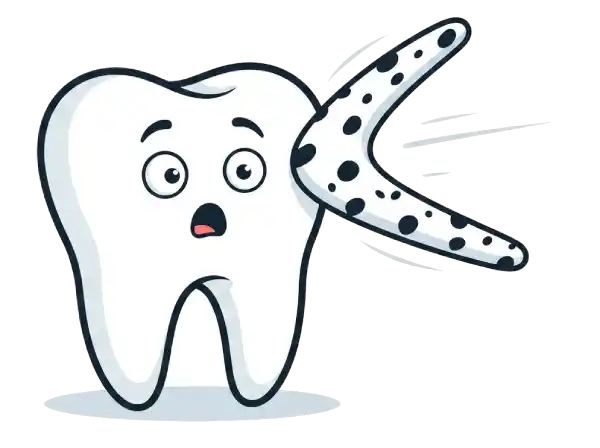
The catch: it comes back. Often within weeks to months. [1,7] The bacteria that caused it are still living in that mouth, and until the oral environment changes, they’ll keep doing their rust-making thing. Some kids need cleanings every 2–3 months if they want to stay stain-free. [1,7] Most parents decide that’s not worth chasing and just let it be.
Daily basics that help either way:
- Brush twice daily with fluoride toothpaste — reduces general plaque buildup, stain included [3]
- Don’t overhaul the diet chasing this — reducing cariogenic, sugar-heavy snacks helps overall mouth health, which matters far more than the cosmetics of one discoloration [3]
- Don’t stop iron supplements because of this. Iron is doing its actual job. The stain is a cosmetic side effect, not a warning sign
There’s also a newer approach — photodynamic therapy, using a light-activated dye to kill the specific bacteria — that showed no recurrence over 7 months in one case report. [10] Interesting. Not mainstream. Not something your local pediatric dentist has in the next room. File it under “future option,” not “ask for this Tuesday.”
Will it just go away on its own? 🔁
Sometimes.
Black stain isn’t permanent by nature — it’s plaque, and plaque comes and goes with the mouth’s changing bacterial balance. Some kids outgrow it as their oral microbiome shifts. Some kids carry a version of it well into adolescence. [3,4] There’s no reliable timeline, and no product that permanently prevents it. [7]
What won’t change is the underlying trade you’re apparently getting: research has repeatedly linked black stain with a lower rate of cavities, likely because the bacteria involved compete with the actual cavity-causing bacteria, and because kids with black stain tend to have saliva with higher calcium, higher phosphate, and better buffering capacity — the stuff that protects enamel. [2,6] One birth-cohort study of over a thousand kids found a roughly 50% lower odds of cavities in children with black stain, even after adjusting for other factors. [6]
So: cosmetically annoying, biologically kind of a bonus.
Nature has a sense of humor. Rarely a kind one. This time, sure.
Bottom line 🎯
Black spots on baby teeth are, almost always, black stain — bacterial, cosmetic, harmless, and mildly protective against the thing you were actually worried about. [1,2,3]
It’s not a hygiene failure.
It’s not the iron’s fault, or the fluoride’s fault, or your fault.
A dentist can clean it off if it bothers you. It’ll probably come back. That’s fine too.
The only version of this that needs a same-week appointment instead of a routine one is discoloration paired with sick-looking gums or other symptoms that have nothing to do with teeth.
Otherwise: keep brushing, keep the iron going if it’s prescribed, and save the worry for something that’s actually trying to hurt you.
Related Reads 🔗
Baby Tooth Turned Grey After a Fall? What It Means
No pain doesn't mean no problem. A grey baby tooth after a bump is a bruise on the inside. Here's what's normal and what needs a dentist.

When to Start Brushing Baby Teeth: A Dentist Explains
Most parents wait too long to start brushing baby teeth, find out smart dentist tips to make it easier, and why you’ll thank yourself later.

Sources
- [1] Takashima Y, Matsumi Y, Yamasaki Y, et al. Black pigmentation in primary dentition: Case report and literature review. *Pediatric Dental Journal*. 2014;24(3):184-188. DOI: 10.1016/j.pdj.2014.09.003
- [2] Żyła T, Kawala B, Antoszewska-Smith J, Kawala M. Black Stain and Dental Caries: A Review of the Literature. *BioMed Research International*. 2015;2015:1-6. DOI: 10.1155/2015/469392
- [3] Bandon D, Chabane-Lemboub A, Le Gall M. Les colorations dentaires noires exogènes chez l'enfant : Black-stains. *Archives de Pédiatrie*. 2011;18(12):1343-1347. DOI: 10.1016/j.arcped.2011.07.014
- [4] Hervochon R, Lisan Q, Rubin F. Recurrent black stains of the tongue and the teeth. *European Annals of Otorhinolaryngology, Head and Neck Diseases*. 2019;136(1):53-54. DOI: 10.1016/j.anorl.2018.11.006
- [5] Garcia Martin JM, Gonzalez Garcia M, Seoane Leston J, Llorente Pendas S, Diaz Martin JJ, Garcia-Pola MJ. Prevalence of black stain and associated risk factors in preschool Spanish children. *Pediatrics International*. 2013;55(3):355-359. DOI: 10.1111/ped.12066
- [6] França-Pinto CC, Cenci MS, Correa MB, et al. Association between Black Stains and Dental Caries in Primary Teeth: Findings from a Brazilian Population-Based Birth Cohort. *Caries Research*. 2012;46(2):170-176. DOI: 10.1159/000337280
- [7] Paredes Gallardo V, Paredes Cencillo C. Tinción cromógena: un problema habitual en la clínica pediátrica. *Anales de Pediatría*. 2005;62(3):258-260. DOI: 10.1157/13071841
- [8] Alazmah A. Primary Teeth Stains and Discoloration: A Review. *Journal of Child Science*. 2021;11(01):e20-e27. DOI: 10.1055/s-0040-1722276
- [9] Li Y, Zhang Q, Zhang F, Liu R, Liu H, Chen F. Analysis of the Microbiota of Black Stain in the Primary Dentition. *PLOS ONE*. 2015;10(9):e0137030. DOI: 10.1371/journal.pone.0137030
- [10] Pessoa L, Galvão V, Damante C, Sant'Ana ACP. Removal of black stains from teeth by photodynamic therapy: clinical and microbiological analysis. *BMJ Case Reports*. 2015;2015:bcr2015212276. DOI: 10.1136/bcr-2015-212276
FAQ: Black Spots on Baby Teeth: Real Answers ❓
What causes black spots on baby teeth?
Is a black dot on my toddler's tooth a cavity?
What does early tooth decay actually look like?
Can iron supplements cause black stains on teeth?
How do I remove black spots on my kid's teeth?
Do black spots on baby teeth go away on their own?
Is it safe to just leave it alone?
Are black spots on teeth ever a sign of something serious?
👶 Part of our Kids Dental Health Guide
This article is part of our Kids Dental Health Guide, where we break down the most common dental problems in children and how to actually deal with them.
About the Author: DMD Alexander K.
Doctor of Dental Medicine with clinical experience treating adults and children. This site focuses on practical prevention, symptom education, and helping patients make informed decisions.
Learn more on the About page.