Tooth Growing in Behind Baby Tooth? Shark Teeth Explained
Last Updated: July 8, 2026
🕒 9 min read

Written by DMD Alexander K.
Doctor of Dental Medicine, 10+ years of clinical experience, focused on preventive dentistry and patient education. Learn more on the About page.

Table of Contents
Wait, why does my kid have two rows of teeth? 🦈
Your six-year-old opens their mouth for a routine “let me see” and you spot it.
A whole extra tooth. Sitting right behind a baby tooth that hasn’t budged.
Two rows. Front and back. Like a tiny, gummy shark.
Take a breath.
This has a name, it’s common enough that dentists have a nickname for it, and it’s rarely the emergency it looks like. [1,4]
It’s called shark teeth — a permanent tooth erupting behind a baby tooth that hasn’t fallen out yet.
If you’ve already been down the “is this normal for my child’s teeth” rabbit hole,
this is the anatomical cousin of that worry:
weird-looking black spots or
fused baby teeth .
👶 Part of our Kids Dental Health Guide
This article is part of our Kids Dental Health Guide, where we break down the most common dental problems in children and how to actually deal with them.
What’s actually happening (the root resorption explainer) 🔬
Here’s the choreography that’s supposed to happen.
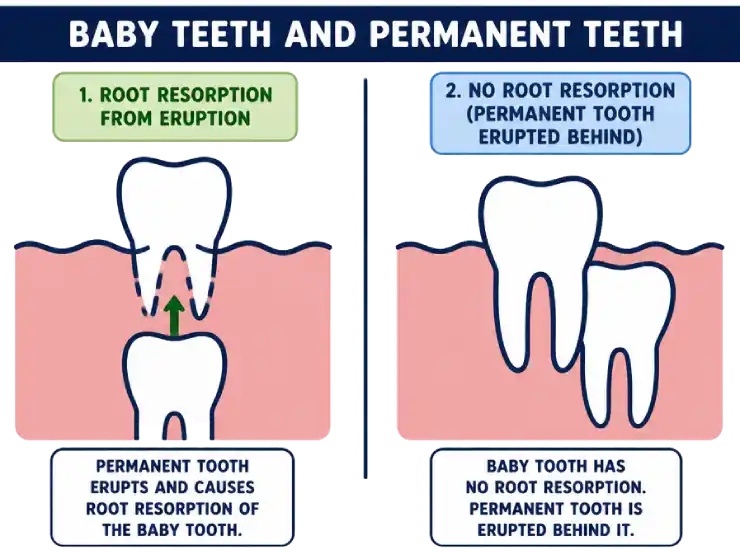
As a permanent tooth develops underneath, it pushes upward. That pressure triggers cells called odontoclasts to dissolve the root of the baby tooth sitting above it. [2,6] The baby tooth root gets shorter and shorter, the tooth gets wobblier, and eventually it falls out — right on schedule, right as the permanent tooth arrives to take its spot.
Choreography. Nice and clean.
Shark teeth happen when the timing — or the positioning — gets out of sync.
The permanent tooth bud is sometimes angled slightly toward the tongue (lingual) or the roof of the mouth (palatal) instead of sitting directly under the baby root. [1,4] When that happens, it doesn’t push straight up into the baby root. It pushes up and around it — taking the path of least resistance, which is often behind the baby tooth rather than through it.
Meanwhile, the baby root — never having felt the pressure it needed — doesn’t resorb properly. It stays put. Firm. Unbothered. While a brand new tooth sets up shop right behind it.
What tips this off balance:
- The permanent tooth bud is slightly misaligned to begin with [1,4]
- The baby root resists resorption or resorbs late [3,6]
- Not enough room in the arch, so the permanent tooth deviates from its path [6,8]
- A previous injury to the baby tooth — especially one that pushed it up into the gum — has shifted the permanent tooth’s position [2,5]
- A supernumerary (extra) tooth or a benign growth is physically in the way [2,7]
None of these are things you caused. This isn’t a flossing problem.
How common is this, really 📊
More common than the “my kid is a genetic anomaly” panic suggests.
The lower front teeth — the mandibular central incisors — are usually the first permanent teeth to erupt, typically around age 6–7. [6,9] They’re also, by a wide margin, the most common site for shark teeth. [6,9]
One long-running study tracked the actual gap between a baby tooth falling out and its permanent replacement showing up. For lower central incisors, the average gap was 14 days. [6] Some kids had a negative gap — meaning the permanent tooth showed up before the baby tooth left. [6] That’s shark teeth, statistically, happening all the time, quietly, without anyone naming it.
Upper front teeth behave more cautiously — the average gap there was closer to six weeks. [6] Which is part of why shark teeth in the upper arch get more attention: it’s less “on schedule” up there, so a lingering baby tooth stands out more.
Exfoliation itself comes in two waves — the front teeth around ages 6–8, then the back teeth (canines and molars) around ages 10–12. [9] The front-teeth wave is where shark teeth show up almost exclusively. If you want the full eruption map for context, the teething chart lays out the whole sequence — this article isn’t trying to re-explain general eruption timing, just the one wrinkle in it.
What to do about it at home 🛠️
For most cases, your job is boring. Boring is good.
Encourage the baby tooth to loosen:
- Let your kid wiggle it. Repeatedly. Annoyingly. That’s the point.
- Firm, crunchy foods — apples, raw carrots — do some of that wiggling for you.
- Keep brushing around both rows carefully. Food traps between a double row of teeth fast, and that’s a gingivitis setup, not a tooth-position problem, but it’s still worth avoiding.
That’s it. That’s the home protocol. Time, pressure, and normal chewing usually do the rest — the tongue pushes the new permanent tooth forward once the baby tooth is finally out of the way. [1,4,6]
What you’re not doing at home: pulling the tooth yourself. Resist the urge, however wobbly it looks.
Do you need to pull the tooth — or braces? 🦷
This is the actual decision tree, so here it is in one place instead of three separate worries.
If the baby tooth is already loose — leave it. It’s on its way out on its own, and pulling it early buys you nothing. [1,6]
If the baby tooth is firm and shows no signs of loosening after several weeks — this is when a dentist typically recommends extracting it. It’s a quick, simple, local-anesthesia procedure. [1,4] One case series found that simply extracting the retained baby tooth led to the permanent tooth correcting its position on its own within about three months — no orthodontics needed. [4]
If nothing happens after the extraction — meaning the permanent tooth still isn’t drifting into place after a few months — that’s when orthodontic help enters the conversation. Sometimes it’s a simple fixed appliance to guide the tooth into alignment. [4] Sometimes it’s about making room if the arch is crowded. [8] Occasionally, for a tooth that’s stuck or badly angled, it needs surgical exposure and guided traction. [1,8]
What you don’t need, almost ever: extraction of the permanent tooth itself. That’s reserved for extreme, rare cases where the adult tooth is severely malformed or unsalvageable — not the standard shark-teeth situation. [2]
The short version: baby tooth loose → wait. Baby tooth firm → dentist removes it. Still stuck after that → orthodontist takes a look. Three steps, not three crises.
When to actually call a dentist 📞
Most shark teeth situations are a “mention it at the next checkup” issue, not a “call today” issue. But make the call sooner if:
- The baby tooth is firm and shows zero signs of loosening after several weeks
- The permanent tooth looks significantly displaced, twisted, or stuck rather than just slightly behind
- There’s visible crowding and you’re not sure there’s room for everything to land correctly
- It’s an upper front tooth situation — upper incisors self-correct less reliably than lower ones, and a maxillary central incisor that hasn’t caught up to its twin within about six months of that tooth erupting is worth investigating regardless of whether a baby tooth is still hanging around [4,8]
- Your child mentions pain, or you notice it’s affecting speech or chewing
Otherwise: this is a wait-and-watch situation with an excellent track record. Most shark teeth resolve with nothing more dramatic than time, a wiggly baby tooth, and maybe one quick extraction. [4,6]
Bottom line 🎯
Two rows of teeth looks like a dental emergency and is, in the vast majority of cases, just a scheduling mismatch between a baby tooth’s exit and a permanent tooth’s entrance. [1,4,6]
The lower front teeth do this constantly — often so briefly nobody notices. The upper front teeth do it less often, self-correct less reliably, and deserve a slightly closer watch.
Give it time. Encourage the wiggle. If the baby tooth won’t budge on its own, a quick extraction usually finishes the job the body didn’t quite manage. Braces are the exception here, not the rule.
Your kid is not, medically speaking, actually turning into a shark. Just borrowing the grin for a few months.
Related Reads 🔗

Black Spots on Baby Teeth: Cavity, Stain, or Fine?
Black dots on your kid's teeth aren't always decay. Sometimes it's bacteria, sometimes it's iron, sometimes it's nothing. Here's how to tell which.
Baby Teething Chart by Age: Interactive Timeline + 101 Guide
See when baby teeth come in with our interactive teething chart. Select your child’s age and explore eruption timelines and tooth replacement.
2-Year Molar Teething: Symptoms & How Long It Lasts
Molars don't ask for permission. They just arrive — loud, angry, and at 2am. Here's what's normal, what's not, and how to actually survive it.
Sources
- [1] Soxman JA, Wunsch PB. Anomalies of tooth eruption. *Clinical Dentistry Reviewed*. 2019;3(1). DOI: 10.1007/s41894-019-0045-9
- [2] Watanabe CT, Watanabe JI, Taguchi Y, Noda T. Eruption disturbances of mandibular permanent incisors. *Journal of Clinical Pediatric Dentistry*. 2001;25(3):181-185. DOI: 10.17796/jcpd.25.3.y5823x83n7380476
- [3] Nagpal A, Sharma G, Sarkar A, Pai K. Eruption disturbances: an aetiological-cum-management perspective. *Dentomaxillofacial Radiology*. 2005;34(1):59-63. DOI: 10.1259/dmfr/14309938
- [4] Suresh KS, Uma H, Nagarathna J, Kumar P. Management of Ectopically Erupting Maxillary Incisors: A Case Series. *International Journal of Clinical Pediatric Dentistry*. 2015;8(3):227-233. DOI: 10.5005/jp-journals-10005-1319
- [5] Aktan AM, Kara I, Sener I, et al. An evaluation of factors associated with persistent primary teeth. *The European Journal of Orthodontics*. 2011;34(2):208-212. DOI: 10.1093/ejo/cjq189
- [6] Nyström M, Peck L. The period between exfoliation of primary teeth and the emergence of permanent successors. *European Journal of Orthodontics*. 1989;11(1):47-51. DOI: 10.1093/oxfordjournals.ejo.a035964
- [7] Shah P, Chander JML, Noar J, Ashley PF. Management of 'double teeth' in children and adolescents. *International Journal of Paediatric Dentistry*. 2012;22(6):419-426. DOI: 10.1111/j.1365-263x.2011.01209.x
- [8] Meade M, Dreyer C. Eruption disturbances in the mixed dentition: orthodontic considerations for primary dental care. *Australian Dental Journal*. 2022;67(S1). DOI: 10.1111/adj.12931
- [9] Ripa LW, Leske GS, Sposato AL, Simon GA, Moresco TV. Chronology and Sequence of Exfoliation of Primary Teeth. *The Journal of the American Dental Association*. 1982;105(4):641-644. DOI: 10.14219/jada.archive.1982.0447
FAQ: Shark Teeth in Kids: Real Answers ❓
Why is my child's new tooth growing in behind their baby tooth?
Is it normal for kids to have two rows of teeth (shark teeth)?
How common is it for permanent teeth to come in behind baby teeth?
Will the baby tooth fall out on its own, or do I need to pull it?
What happens if I don't pull the loose baby tooth?
Do kids with shark teeth need braces?
Will my child's shark tooth move forward into place on its own?
When should I actually call a dentist about it?
👶 Part of our Kids Dental Health Guide
This article is part of our Kids Dental Health Guide, where we break down the most common dental problems in children and how to actually deal with them.
About the Author: DMD Alexander K.
Doctor of Dental Medicine with clinical experience treating adults and children. This site focuses on practical prevention, symptom education, and helping patients make informed decisions.
Learn more on the About page.