Baby Teething Chart by Age:
Interactive Timeline + 101 Guide
Last Updated: April 13, 2026
🕒 10 min read

Written by DMD Alexander K.
Doctor of Dental Medicine, 10+ years of clinical experience, focused on preventive dentistry and patient education. Learn more on the About page.
Table of Contents


Interactive teething timeline
Move the age slider to preview a front-view mouth where teeth emerge from the gum line over time.
Primary teeth mouth map
Current snapshot
8 teeth expected to be visible in the current mouth view.
6 teeth are in their active eruption window.
Now emerging: Upper Lateral incisor (left), Upper Central incisor (left), Upper Central incisor (right), Upper Lateral incisor (right), Lower Lateral incisor (left).
Drooling indicator: High
Drooling often peaks during front-to-molar eruption windows.
Expected symptoms
- Common: drooling, gum swelling, chewing on objects, and mild irritability.
- Teeth often erupt in pairs, especially in the front.
- Comfort options: cold washcloth, teething ring, or gentle gum massage.
- Start brushing with a tiny smear of toothpaste as soon as first teeth appear.
What comes next
- Upper First molar (2 teeth): 1y 1m-1y 7m
- Lower First molar (2 teeth): 1y 2m-1y 6m
- Upper Canine (2 teeth): 1y 4m-1y 10m
- Lower Canine (2 teeth): 1y 5m-1y 11m
This chart is a guidance tool. Individual eruption timing varies and should be interpreted with your dentist.
When Do Baby Teeth Come In? (Complete Teething Timeline)
Let’s get one thing straight.
Babies don’t read schedules.
There’s a “typical” teething timeline — and then there’s your child, doing whatever they feel like doing.
One kid gets teeth at 4 months. Another waits until 10.
Both end up biting you eventually.
So no, this isn’t a strict calendar. It’s a reference.
Use the chart above to see:
- which teeth usually appear at a certain age
- the general eruption order
- when baby teeth are replaced later on
- when drooling and chewing usually start
- what symptoms are normal at each stage
- what comes next
If your child is a bit early or late, that’s normal.
If you’re expecting perfect timing… you’re going to be disappointed.
Teething is messy.
The chart just makes it slightly less confusing.
When the first tooth appears, you can already start implementing the brushing routine.
You will thank yourself later.
🦷 First teeth (4–7 months): The Opening Act Nobody Asked For
The lower central incisors usually show up first. Two little white edges forcing their way through the gum like they own the place.
Your baby will drool. Excessively. On everything. Including you.
They’ll chew on anything they can reach. Toys. Fingers. The corner of your phone.
Their gums will look swollen and irritated.
All of that? Normal.
What’s not normal: high fever, diarrhea, or a rash spreading beyond the face. Those aren’t teething. Those are something else wearing teething as a disguise.
😬 Front teeth (8–12 months): More of the Same, Louder
Upper and lower lateral incisors join the party. By 12 months, most babies have 4 to 8 teeth in various stages of eruption.
The pattern is usually: bottom center → top center → sides.
Except when it isn’t. Because babies.
If nothing has appeared by 12 months, worth a dentist visit — not a panic spiral, just a check.
😤 Back teeth and molars (12–24 months): The Hard Part
First molars arrive around 12–16 months. Then canines. Then second molars, usually by 24 months.
This is the stage parents dread most, and for good reason. Molars are wider. The pressure before eruption is more intense. Sleep gets worse. Mood gets worse. Everyone’s mood gets worse.
The good news: by around 2.5 to 3 years, the full set of 20 baby teeth is usually in place.
The bad news: then the permanent teeth start showing up. But you have a few years before that problem.
✅ Full set complete (2–3 years)
Twenty baby teeth. All present. All accounted for.
Teeth brushing should start already with the first tooth , but…
This is a good moment to establish a proper brushing routine if you haven’t already — twice a day, fluoride or non-fluoride toothpaste, grain-of-rice sized amount for under 3.
Not because they’ll thank you.
Because future-you will.
How to Use This Teething Chart
Move the age slider and watch what changes.
No guesswork. No Google rabbit holes.
Click on any tooth to see:
- when it usually erupts
- when it’s replaced by a permanent tooth
Use it as a guide, not a source of panic.
What’s Normal at Each Teething Stage
Most teething symptoms are the same regardless of which tooth is coming in. Drooling, chewing, irritability, disrupted sleep, slightly swollen gums.
What changes is the intensity — molars cause more discomfort than incisors because of their surface area. That’s it. No mystery.
🌡️ Teething fever: what temperature is actually normal?
Teething might slightly raise a baby’s temperature. Slightly.
Anything above 38°C (100.4°F) is not from teething.
Let that sink in, because it matters.
Blaming a real fever on teething is how infections get missed.
Ear infections, throat infections, viral illnesses — they all love to show up right when a tooth is coming in,
because a teething baby puts hands and objects in their mouth constantly.
Convenient timing. Coincidence, not causation.
If you want to win a parent debate, you should read this article:
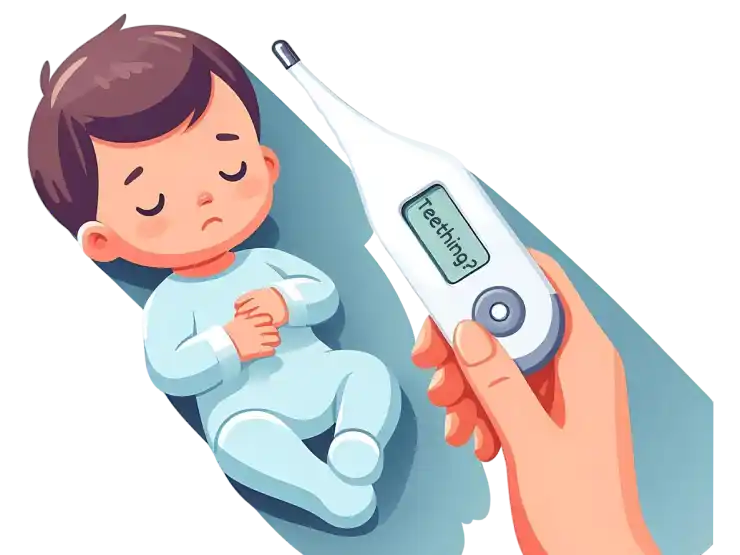
The rule: mild fussiness and marginally elevated temperature during teething — fine. Fever above 38°C — not teething, consider scheduling a doctor appointment. Don’t negotiate with it.
🔴 Teething rash: where it appears and why
Excess saliva sitting on your baby’s chin, neck, and chest causes skin irritation. It’s not a mysterious rash. It’s drool. Doing what drool does.
It looks red, slightly raised, and shows up exactly where the saliva pools — around the mouth, chin, and neck folds.
What to do: keep it dry. Petroleum jelly on the chin creates a barrier. Gentle patting, not wiping. It resolves when teething slows.
What it’s not: an allergic reaction, a viral rash, or anything requiring urgent attention — unless it spreads beyond the drool zone, changes in character, or your child develops other symptoms.
You are suspecting teething rash? Be 100% sure and confirm with this article:
⏱️ When teething pain peaks — and when it gets easier
Pain is highest in the 24–72 hours before a tooth breaks through the gum. Once it’s through, pressure drops, discomfort drops, baby drops back to something resembling a normal human.
The total eruption process for a single tooth can take 1–8 weeks from first symptoms to full emergence. Molars take longer. Incisors are faster.
There is no shortcut. Cold teething rings, gentle gum massage, distraction. If medication is needed frequently, talk to a doctor about appropriate dosing — don’t wing it.
Teething Order: What If Teeth Come In Wrong? 🤔
Here’s what nobody tells you: teeth don’t always follow the textbook order.
Lower central incisors usually come first. But sometimes the uppers appear first. Sometimes a lateral incisor shows up before a central one. Sometimes there’s a gap in the sequence that makes you convinced something is wrong.
Usually, it isn’t.
What actually warrants attention:
- Teeth erupting in a dramatically asymmetric pattern (one side significantly ahead of the other)
- A tooth erupting in an obviously abnormal position — rotated, deeply displaced, erupting through the wrong part of the gum
- Missing teeth with no sign of eruption by 12–15 months
- Teeth coming in with visible discoloration or structural abnormalities at eruption
The sequence matters less than the eventual result. If all 20 baby teeth arrive within a reasonable timeframe and the bite looks roughly symmetrical, you’re fine.
If something genuinely looks off — not “different from the chart” off, but structurally wrong off — that’s what dentist appointments are for.
Along the teething journey, many rare but documented variations exist. Most of the time it’s not something to worry about, but it can be surprising. As a caring parent, these things just wait around the corner so they can live rent free in your mind. Let’s contain them:

Tooth Growing in Behind Baby Tooth? Shark Teeth Explained
Two rows of teeth out of nowhere isn't a crisis. Dentists call it shark teeth. Here's what's actually happening — and when it's worth a call.
Baby Tooth Looks Like Two Teeth Joined Together? Why
One oversized tooth where there should be two isn't a mistake in nature. Dentists call it a fused tooth. Here's what it means, calmly.
When Baby Teeth Fall Out (Permanent Tooth Timeline)
Baby teeth are not permanent. That’s literally in the name. Here’s what replaces them, and when.
🦷 First permanent molars (6–7 years): The Most Important Teeth You’ll Ever Ignore
First permanent molars are sneaky. They don’t replace a baby tooth — they erupt behind the existing baby teeth, in empty space at the back of the jaw.
No baby tooth falls out first!
No obvious signal that anything is happening.
Which means parents miss them constantly.
If preventive dentistry could have a mascot, it would be the first permanent molar.
This is the most important dental moment in your child’s life up to this point, and it arrives without fanfare.
Why it matters: first molars are the foundation of the bite. They set the position for every other permanent tooth that follows. They have deep grooves that trap food and bacteria. They’re also still mineralizing when they erupt — meaning the enamel is softer and more vulnerable to cavities than it will be in a year.
If your child could go to the dentist exactly once, it should be around age 6 to check these teeth.
Sealants are worth discussing. Not optional, worth discussing. The dentist will tell you if they’re needed.
A cavity in a first permanent molar at age 6 is not a small problem. It’s a root canal waiting to happen.
And sometimes it happens, unfortunately. But it’s not all over, and you need to regain your focus and make a right decision what to do with a huge cavity in a first permanent molar:
🦷 Canines and premolars (10–12 years): The Orthodontic Window
Between 10 and 12, the canines and premolars are replaced. This is when the mouth starts looking more adult — and when crowding problems become visible.
Here’s the thing about crowding: the best time to address it is before it’s fully established, not after. Jaw growth is still happening at this age. Guiding it is possible. Waiting until 16 and then extracting teeth and using fixed braces is more expensive, more uncomfortable, and less effective than early intervention.
This isn’t a pitch for unnecessary orthodontics. It’s a prompt to get an orthodontic evaluation around age 10–11 if you haven’t already. Let a professional tell you there’s nothing to do — that’s a fine outcome. But don’t skip the evaluation.
🦷 Wisdom teeth (17–21 years): Everyone’s Least Favorite Chapter
Third molars. Wisdom teeth. The teeth that nature forgot to cancel.
They erupt — or attempt to — between 17 and 21. In most modern jaws, there isn’t room. They get impacted, partially erupt, or come in at angles that damage the neighboring second molar.
Not everyone needs them removed. Some people have adequate space. Some wisdom teeth never cause problems. Some never fully erupt at all.
What you want is monitoring, not panic. Panoramic X-rays around age 17–18 show where they are, how they’re positioned, and whether they’re heading somewhere problematic. If removal is indicated, doing it at 18–20 is easier, faster, and heals better than waiting until 30 when the roots are fully formed and anchored.
Don’t wait for pain. By the time wisdom teeth hurt, they’ve usually already caused damage.
Be wiser than your wisdom teeth.
When to Call a Dentist 📞
Most teething questions answer themselves with time. A few don’t.
Call a dentist if:
- No teeth by 12–13 months
- A tooth erupts visibly misaligned or in the wrong location
- Fever above 38°C during apparent teething symptoms
- A tooth appears discolored or structurally abnormal at eruption
- Gums look infected around an erupting tooth (swollen, painful, pus)
- Your child is in significant pain that doesn’t respond to normal comfort measures
Don’t call a dentist for:
- Being two months “behind” the chart
- Teeth coming in a slightly different order than expected
- Drooling, chewing, irritability, or mild sleep disruption
- A tooth that takes 6 weeks to fully emerge
The chart is a reference range. Your child is not a chart.
Related Topics Parents Ask
Teething Questions Parents Actually Ask
When do babies start teething?
What are the first signs of teething?
Can teething cause fever?
How long does teething last?
What helps with teething pain?
When should I worry if teeth are late?
What if my baby's teeth are coming in crooked?
When do baby teeth fall out?
Do teething babies need to see a dentist?
About the Author: DMD Alexander K.
Doctor of Dental Medicine with clinical experience treating adults and children. This site focuses on practical prevention, symptom education, and helping patients make informed decisions.
Learn more on the About page.