Dentist Hit a Nerve While Giving a Shot? What Happens Next
Last Updated: November 17, 2026
🕒 12 min read

Written by DMD Alexander K.
Doctor of Dental Medicine, 10+ years of clinical experience, focused on preventive dentistry and patient education. Learn more on the About page.
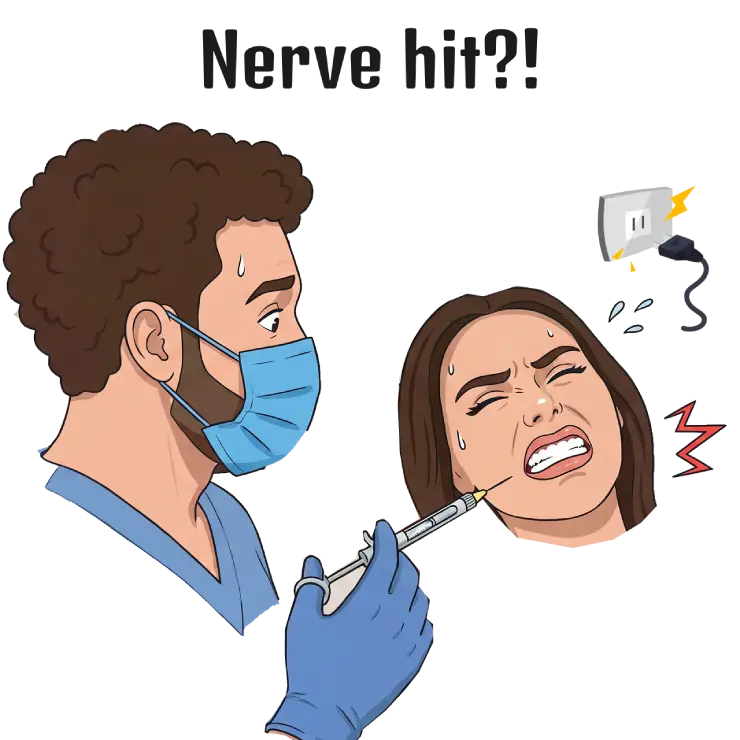
Table of Contents
Zap. Like a Live Wire in Your Lip 😬
Zap. Like a live wire in your lip. Then the dentist says “sorry, that happens” and keeps drilling.
Let’s talk about that, because “sorry, that happens” is a true statement and also a deeply unsatisfying one, and you deserve better than a shrug on your way out the door.
On the other hand, from a dentist’s perspective, it’s very annoying because it often happens when you do everything right, there isn’t anything you could do about it, except to leave this bad impression on the patient.
Here’s the thing nobody tells you in the chair: that zap has an actual explanation, a real set of odds attached to it, and a specific plan of action — none of which you got, because your dentist was mid-procedure and not running a seminar. I’ll run the seminar.
🦷 This article is part of our Adult Oral Health Guide Adult Oral Health Guide, where we break down the most common dental problems and how to actually deal with them.
Related Reads 🔗

Numb Lip After Wisdom Teeth? Here's What's Normal
No pain, no feeling — and that's the confusing part. Here's how long numbness should last after wisdom teeth, and when it's actually a problem.
Can't Open Your Mouth After Dental Work or a Numbing Shot
Mouth won't open fully after the dentist or a numbing shot? Usually a sore muscle, not a lock. Normal timeline, home fixes, red flags to call about.
Bruised Cheek After a Dental Injection? What It Means
A dental injection isn't supposed to leave a bruise — but sometimes it does. Here's why, how long it lasts, and when it's actually a problem.
Double Vision After a Dental Injection? Here's Why
Seeing double right after a numbing shot is rare, real, and not a stroke. Here's the actual reason — and how long it takes to clear up.
Short Answer 🚀
A zap during the shot means the needle touched, nudged, or passed close to a nerve. Most of the time that’s the entire story — momentary, forgotten by lunch. A minority of people end up with numbness, tingling, or a pins-and-needles feeling that outlasts the numbing medicine itself. Most of those recover over weeks to months. Permanent nerve damage is genuinely rare — estimates range from about 1 in 20,000 injections to as low as 1 in 800,000, depending on how the data was collected [2,4]. Those numbers are all over the map because nobody agrees on how to count this, but the direction they all point in is the same: the odds favor you.
First, Which Nerve Do You Mean? 🧭
Before we go further, I need you to actually answer this question, because “nerve” is doing double duty in dentistry and people mix the two up constantly.
Is this pain while the drill is running, deep in the tooth itself? That’s the nerve inside the tooth — the pulp — reacting to the drilling, and it’s a completely different situation from what this article covers. If that’s your actual complaint, you want this article on tooth pain from the nerve inside the tooth instead, not this one.
Or is this a zap or lasting numbness in your lip, chin, or tongue, tied to the numbing shot itself — the needle, not the drill? That’s a jaw nerve the needle passed near, and that’s what the rest of this article is actually about.
Good. Now that we’ve sorted out which crime scene we’re at, let’s look at the body.
What Actually Happens When a Needle Meets a Nerve ⚡
The most common numbing shot for lower back teeth — the inferior alveolar nerve block, or IANB in the jargon — is given blind. Your dentist can’t see the nerve. They’re aiming at it using bone and soft tissue landmarks, from memory and feel, into a space where the nerve to your lower lip and chin, the nerve to your tongue, and some small blood vessels are all sitting within a few millimeters of where the needle tip ends up. That’s not sloppy technique. That’s the actual geometry of your jaw, and every dentist on earth works with the same few millimeters of wiggle room.
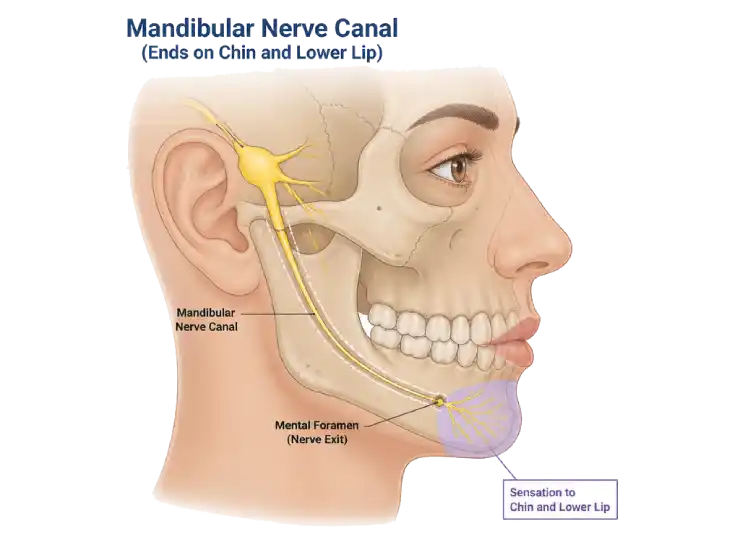
Where it says 'Mandibular Nerve Canal' is the exact location where a dentist aims the needle to put the anesthetic near the nerve. If it's not near the nerve, then you feel the pain and there is no point into that.
Three things can happen when the needle gets too close:
Direct contact or a nick. The needle touches or passes through part of the nerve bundle. Mechanical, physical, over as soon as the needle is withdrawn.
A bit of internal bleeding. Blood inside the nerve’s own sheath creates pressure and, later, scar tissue, which can squeeze the nerve from the inside rather than cutting it.
Chemical irritation. The numbing medicine itself, when it ends up concentrated right inside or immediately next to the nerve rather than around it, can irritate the nerve fibers directly [1-4].
Here’s the detail that should permanently change how you think about that zap: feeling an electric shock during the injection is a genuinely unreliable warning sign. Only somewhere between about 1.3% and 8.6% of people getting this exact shot report feeling a shock at all [2]. And in the opposite direction — among people who went on to develop actual lasting numbness, 57% said their injection felt completely painless at the time [2]. One study of 1,000 blocks found that nobody who developed lasting numbness had felt a shock or an unusually painful injection going in [1]. The zap and the injury are only loosely related. You can get one without the other, in either direction.
How You’d Know 🔍
A zap alone doesn’t prove anything happened. What actually tells you something’s off is what comes after the anesthetic should have worn off: numbness that’s still there past the normal window, a tingling or burning sensation where there shouldn’t be one, a change in how things taste, or trouble eating or speaking cleanly because part of your mouth isn’t cooperating the way it should.
If any of that sounds familiar and you’re also still numb from a dental extraction specifically rather than a routine filling or cleaning, the extraction version of this has its own detailed breakdown in numb lip after wisdom tooth removal , which covers wear-off timing specific to that procedure.
Tongue Numbness After Dental Work 👅
The nerve to your tongue — the lingual nerve — is actually the one most commonly affected by this kind of injury, for a fairly unglamorous anatomical reason: it gets stretched and pinned against a muscle when your mouth is held wide open, and at the exact point where the needle usually passes nearby, it’s often a single bundle of fibers rather than several — which makes it more fragile than the nerve running to your lip, which is built as multiple separate bundles side by side [2,4,5].
If this nerve is affected, you’ll notice it as numbness or tingling in your tongue, the floor of your mouth, or the gum tissue on the tongue side of your lower teeth — and sometimes a genuinely strange side effect: a change in taste on the front two-thirds of your tongue, because a taste nerve rides alongside this same nerve for part of its route [2,4]. If your lip and chin feel normal but your tongue doesn’t, that’s actually useful diagnostic information — it tells your dentist which specific nerve got involved, which matters for how closely it needs to be watched.
Normal Wear-Off vs. Too Long ⏱️
Ordinary numbness from a dental injection — no nerve injury involved, just the anesthetic doing its job — wears off within a few hours, depending on which drug and how much was used. That part is expected and boring, and it’s not what we’re talking about here.
What’s not expected: numbness, tingling, or burning that is still there well after the anesthetic should have worn off, stretching into the next day or beyond. In a large prospective study, the vast majority of these injuries that weren’t caused by actual surgery in the same area turned out to be temporary — and most resolved within weeks, not months [1]. In specialist referral clinics, the working rule is that 85-94% of these injuries recover by 8 weeks, and 81% of lower-jaw-nerve cases have already resolved by just 2 weeks [2]. The risk of this becoming permanent doesn’t rise sharply until you’re past that 8-week mark.
So: a day or two of lingering numbness is not yet a red flag. Weeks of it, with no improvement, is the point where “wait and see” stops being the right strategy.
Does It Heal, and How Long? 🌱
“Nerve irritated, not cut” is the phrase that actually matters here, because it describes the large majority of these cases. The nerve wasn’t severed. It was bruised, compressed, or chemically irritated — all of which are things nerves are reasonably good at recovering from on their own, given time.
Timeline, realistically: most cases that are going to resolve, resolve within the first 2 to 8 weeks [1,2]. Beyond that window, improvement gets slower and less certain, which is exactly why the next section — the “what to do now” section — puts a number on how long is too long to just keep waiting.
What to Do Now 🛠️
If this is happening to you right now, or happened recently, here’s your actual to-do list, not a vague “keep an eye on it”:
Call your dentist’s office and tell them exactly what you felt — not a vague “my lip feels weird,” but specifics: when it started, whether it was a sharp shock during the injection or just numbness you noticed afterward, and exactly which area is affected (lip, chin, tongue, one side or both).
Write down the date and what happened, in your own words, while you still remember it clearly. This isn’t about building a legal case — it’s about having an accurate timeline if your dentist or a specialist needs to track whether you’re improving or not.
Protect the numb area. A numb lip or tongue doesn’t feel pain the way it should, which means you can genuinely injure yourself without noticing — biting your own lip or tongue while eating, or burning yourself on hot food or a hot drink you can’t properly feel. Be deliberately careful with temperature and with chewing until sensation is back to normal.
I’m not going to hand you nerve-pain medication advice here — that’s a prescribing decision between you and whoever’s actually treating you, not something to self-direct off a blog post.
See an oral surgeon if it isn’t improving. This is the single most important actionable fact in this entire article, so I’m not burying it: in one recent case series, patients whose symptoms eventually improved had been referred to a specialist after an average of 8.6 weeks — patients who didn’t improve had waited an average of 44.1 weeks before anyone referred them on [9]. That gap is not a coincidence. Earlier referral is consistently linked to better outcomes, and the improvement rate drops noticeably after the 12-week mark. Don’t wait for your dentist to bring it up if they aren’t already tracking you closely — ask directly whether this needs a specialist referral.
One more thing, because it needs saying plainly: none of this is legal advice. This article explains the medicine. What you do about documentation, complaints, or anything beyond your own recovery is a separate conversation with separate professionals.
When to Call Urgently 🚨
Most of what we’ve covered is a “monitor and follow up” situation, not an emergency. These specific things are not:
New facial weakness that shows up after the anesthetic should have already worn off — one side of your face drooping, not just numb, days or hours after a numbing shot that should be long gone. Treat this as a possible stroke until a medical professional proves otherwise. This is not dental advice hedging — true nerve-block complications don’t cause delayed-onset facial weakness; a stroke can, and timing is everything with stroke treatment.
Severe, worsening pain rather than numbness. Swelling along with a fever. Trouble breathing or swallowing. Any of these get you to urgent or emergency care, not a wait-for-Monday phone call.
Bottom Line 🎯
A nerve getting nicked by a dental needle is a known, documented, largely unavoidable risk — it happens even when the technique is textbook-perfect, because the anatomy leaves only a few millimeters of margin to work with. Most cases are temporary and resolve within weeks. The ones that don’t resolve on their own have the best shot at a good outcome when they’re referred to a specialist early rather than left to “wait and see” for months.
Document it. Follow up. Don’t panic. And if you’re still numb at week six with nobody actively tracking it, make the appointment yourself.
Sources
- [1] van der Sleen JM, Jaspers GW, de Lange J. Trigeminal nerve paraesthesia from inferior alveolar nerve blocks: incidence and course. *Oral Surgery*. 2015;8(4):217-220. DOI: 10.1111/ors.12157
- [2] Renton T. Prevention of iatrogenic inferior alveolar nerve injuries in relation to dental procedures. *Dental Update*. 2010;37(6):350-363. DOI: 10.12968/denu.2010.37.6.350
- [3] Kim EJ, Kim HY, Ahn JH. Neurotoxicity of local anesthetics in dentistry. *Journal of Dental Anesthesia and Pain Medicine*. 2020;20(2):55. DOI: 10.17245/jdapm.2020.20.2.55
- [4] Tan YZ, Shi RJ, Ke BW, Tang YL, Liang XH. Paresthesia in dentistry: the ignored neurotoxicity of local anesthetics. *Heliyon*. 2023;9(7):e18031. DOI: 10.1016/j.heliyon.2023.e18031
- [5] Garisto GA, Gaffen AS, Lawrence HP, Tenenbaum HC, Haas DA. Occurrence of paresthesia after dental local anesthetic administration in the United States. *The Journal of the American Dental Association*. 2010;141(7):836-844. DOI: 10.14219/jada.archive.2010.0281
- [6] Pogrel MA. Permanent nerve damage from inferior alveolar nerve blocks: a current update. *Journal of the California Dental Association*. 2012;40(10):795-797. DOI: 10.1080/19424396.2012.12220955
- [7] Ngeow WC, Chai WL. Numbness of the ear following inferior alveolar nerve block: the forgotten complication. *British Dental Journal*. 2009;207(1):19-21. DOI: 10.1038/sj.bdj.2009.559
- [8] Pippi R, Spota A, Santoro M. Medicolegal considerations involving iatrogenic lingual nerve damage. *Journal of Oral and Maxillofacial Surgery*. 2018;76(8):1651.e1-1651.e13. DOI: 10.1016/j.joms.2018.03.020
- [9] Park KJ, Choi E, Jung IY, Kim ST. Pharmacologic management of trigeminal nerve injury after endodontic treatment: a retrospective analysis. *Journal of Oral Rehabilitation*. 2024;51(9):1737-1747. DOI: 10.1111/joor.13765
- [10] Ryan K, Crighton A. Trigeminal neuralgia and trigeminal neuropathic pain. *British Dental Journal*. 2024;236(4):323-328. DOI: 10.1038/s41415-024-7068-6
- [11] Alharbi G, Rao JKD, Alnaim T, Alzamil N, Nagarajappa R. Efficacy of low-level laser therapy and microsurgery on neurosensory recovery following inferior alveolar and lingual nerve injuries: a systematic review. *Journal of Oral Biology and Craniofacial Research*. 2024;14(5):631-637. DOI: 10.1016/j.jobcr.2024.08.006
- [12] Bagheri S, Meyer R, Cho S. A retrospective review of microsurgical repair of 186 inferior alveolar nerve injuries. *Journal of Oral and Maxillofacial Surgery*. 2010;68(9):e27-e28. DOI: 10.1016/j.joms.2010.06.040
- [13] Stirrup P, Crean S. Does articaine, rather than lidocaine, increase the risk of nerve damage when administered for inferior alveolar nerve blocks in patients undergoing local anaesthesia for dental treatment? A mini systematic review of the literature. *British Dental Journal*. 2019;226(3):213-223. DOI: 10.1038/sj.bdj.2019.98
- [14] Orr DL II, Curtis WJ. Obtaining written informed consent for the administration of local anesthetic in dentistry. *The Journal of the American Dental Association*. 2005;136(11):1568-1571. DOI: 10.14219/jada.archive.2005.0090
FAQ: Dentist Hit a Nerve During Injection Real Answers❓
What happens if a dentist hits a nerve with the injection?
How do I know if the needle hit a nerve?
Is the electric shock feeling during an injection dangerous?
How long does a needle-irritated nerve take to heal? Will it heal by itself?
Is nerve damage from a needle permanent?
Why is my tongue numb days after dental work?
What should I do if I think my dentist hit a nerve?
Is it the anesthetic or the needle?
About the Author: DMD Alexander K.
Doctor of Dental Medicine with clinical experience treating adults and children. This site focuses on practical prevention, symptom education, and helping patients make informed decisions.
Learn more on the About page.