Roof of Mouth Sore After a Dental Injection? Why It Hurts
Last Updated: July 11, 2026
🕒 11 min read

Written by DMD Alexander K.
Doctor of Dental Medicine, 10+ years of clinical experience, focused on preventive dentistry and patient education. Learn more on the About page.
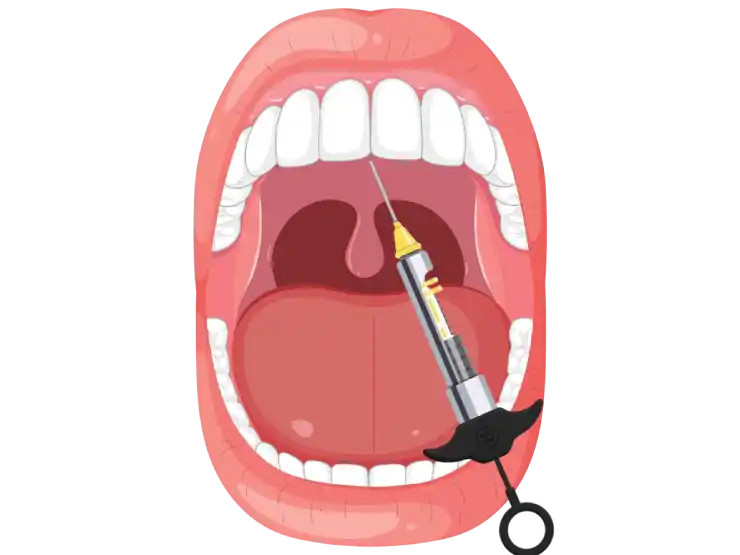
Table of Contents
Why does my palate hurt after that shot? 💉
You had a filling, maybe a root canal, on an upper tooth. Somewhere in the process, the dentist numbed the roof of your mouth directly — not just the cheek side, the actual palate. It stung more than you expected at the time. A day or two later, there’s a tender spot up there, sometimes even a small sore.
You didn’t get hit in the face. You got a palatal injection, and your palate is telling you about it.
Here’s the short version before the mechanism: this is a known complication, it’s uncommon, and it heals. [1] It is not, in the vast majority of cases, a sign anyone did anything wrong. It’s a side effect of injecting into one of the least forgiving pieces of real estate in your mouth.
🦷 Part of our Adult Oral Health Guide
This article is part of our Adult Oral Health Guide, where we break down the most common dental problems and how to actually deal with them.
What’s actually happening (tight tissue, restricted blood flow) 🔬
Most of your mouth’s soft tissue has some give to it. It can stretch, absorb a needle, distribute fluid. Your palate does not have that luxury.
The mucosa on the roof of your mouth is thin and bound down tightly to the bone underneath, with essentially no loose connective tissue to cushion an injection. [1] When anesthetic goes in there, it has nowhere to spread out. It sits, under pressure, in a confined space.
Add the anesthetic’s usual passenger — epinephrine, there to constrict blood vessels and make the numbing last longer — and you get a combination of three things happening at once in a tissue that can’t absorb any of them gracefully: [1]
- Direct trauma from the needle itself
- Fluid pressure from anesthetic with nowhere to go
- Vasoconstriction, cutting local blood flow further
The result, in a small number of cases, is what’s technically called a trophic ulcer — tissue that didn’t get enough blood supply for long enough, died off in a small area, and ulcerated. [1] The classic version shows up as a reddened patch about 1–2 centimeters wide with an ulcer in the center, usually sitting right over the spot where the greater palatine nerve exits the bone — which happens to be a very common injection target for numbing the back upper teeth. [1] It’s typically mild discomfort, not agony, and it takes weeks rather than days to fully close.
This isn’t your only souvenir option from a dental injection, for what it’s worth. The same shot, aimed at a slightly different structure, can leave you with lingering numbness instead — that’s nerve territory, covered in the numb lip guide . A punctured vessel produces a bruise that changes color over days, detailed in the bruised cheek guide . And a vessel that clamps down without actually rupturing produces a pale, painless patch that’s usually gone within the hour, covered separately in the white patch guide . Four different structures, four different outcomes, one injection. Your palate drew the “restricted blood flow in tissue with nowhere to expand” card.
There’s also a second, more common cause worth naming honestly: you probably bit yourself. Numbness doesn’t respect boundaries — while the palate is anesthetized, some people bite, poke, or chew on it without realizing, simply because it doesn’t hurt yet. One study of pediatric patients found soft tissue injury from exactly this in 13% of children after a mandibular block, with the highest rate — 18% — in kids under four. [7] Adults do this too, usually while eating too soon after the appointment, before feeling comes back. [6,7]
How long it normally takes to heal 📅
Depends which version you have, so let’s separate them.
Ordinary trophic ulceration: weeks, not days — this one takes its time, generally healing over a period of several weeks with nothing more than basic care. [1]
Self-inflicted bite trauma: faster, typically 7 to 14 days, following roughly the same timeline as any minor bite wound elsewhere in the mouth. [7]
Necrotizing sialometaplasia — a rarer, stranger-looking condition covered in the next section — actually resolves within 4 to 10 weeks on its own, despite looking considerably more alarming than the other two. [10]
None of these are quick. If you’re expecting a canker-sore-style week-and-done timeline for actual trophic ulceration, adjust that expectation now — palatal tissue heals slowly because it’s tightly bound and doesn’t have much blood flow to spare to begin with, which is rather the whole problem in the first place.
Sore, or something more serious? (the rare stuff — necrosis, perforation) 🚨
Here’s the section where the rare, ominous-sounding diagnoses live. Named, described briefly, and put back in their box.
Necrotizing sialometaplasia sounds like something from a medical drama and is, in fact, entirely benign. It happens when ischemia — reduced blood flow — damages the small salivary glands under the palate, causing a deep, crater-shaped ulcer that can look strikingly similar to oral cancer on inspection. [10] It’s often preceded by a painless swelling that later breaks down into the ulcer, averages under 2 centimeters, and is frequently painless or nearly so. [10] Because it can mimic malignancy so convincingly under the microscope, a biopsy is standard practice to confirm the diagnosis — not because anyone thinks it’s cancer, but because ruling it out properly matters more than assuming. [10] It heals without treatment, without scarring, within 4 to 10 weeks. [10]
Chemical injury — an accidental injection of an irritant solution like the bleach-based liquid used to clean out root canals, instead of anesthetic — is a genuine, documented complication, and genuinely rare, given how deliberately those solutions are kept separate from anesthetic cartridges. [3] When it has happened, it caused immediate severe pain and a small area of tissue death that, notably, still healed within about a month without leaving a scar. [3]
Palatal necrosis from an intra-arterial injection — anesthetic accidentally entering a small artery and causing a vasospasm severe enough to kill tissue — is real, has been documented, and is uncommon enough that it shows up as individual case reports rather than statistics. [5]
All three of these are the zebras. If you hear hoofbeats after a palatal injection, it’s ordinary ulceration or a bite wound, not one of these. They’re named here so you recognize them if your dentist mentions them, not because you should be diagnosing yourself with any of them from a mirror check at home.
Canker sore or injection soreness — how to tell 🔍
This is genuinely the most useful question in this whole article, because “sore on the roof of my mouth” pulls up canker sore content whether or not that’s what you actually have.
Timing tells you a lot. Injection-related soreness and ulceration typically show up within hours to a couple of days of the appointment — it’s directly downstream of something that happened in that chair. A canker sore, by contrast, can show up any time, triggered by all sorts of things — minor trauma among them, but also stress, certain foods, or nothing identifiable at all.
Location is the bigger tell. Injection-related soreness sits precisely where the needle went — almost always over or near the greater palatine foramen, the standard target for numbing the back upper teeth. [1] A canker sore can show up anywhere on the palate, or anywhere else in the mouth for that matter, with no relationship to where a needle has ever been.
Cause, if you want the mechanism version: injection soreness is a circulation problem — reduced blood flow to tissue that had nowhere to absorb the trauma. A canker sore is an immune-system event, an ulcer your body decided to create in response to some trigger, mechanical or otherwise. Different biology entirely, even though the end result — a sore spot in your mouth — looks superficially similar to the naked eye.
If your sore appeared days after a completely unrelated stretch with no dental visit in sight, sits somewhere random rather than exactly at an injection site, and follows the pattern of coming and going the way these things do for you personally — that’s very likely a garden-variety canker sore, and the canker sores guide is the more useful read from here.
What to actually do about it 🛠️
For ordinary post-injection soreness:
- Time and basic hygiene do most of the work. Gentle brushing and a chlorhexidine mouth rinse, if your dentist recommends one, help keep the area clean while it heals. [7]
- Over-the-counter pain relief — acetaminophen or ibuprofen — handles the discomfort. [1]
- Skip spicy, hot, or acidic food and alcohol while it’s healing. This isn’t optional advice you can substitute with willpower; acidic food on an open palatal ulcer is exactly as unpleasant as it sounds.
- A topical numbing gel can help temporarily, used sparingly rather than constantly.
For bite trauma specifically:
- Same basic care — rinses, gentle hygiene, avoiding irritants.
- Watch your kids more closely than usual right after a dental appointment; that 13–18% bite-injury rate in children isn’t a small number, and a numb mouth combined with an unsupervised snack is a predictable combination. [7]
- Adults: don’t test whether you can still feel your palate by chewing on something. You can’t. That’s the point of the numbness.
Across the board: if it’s not visibly getting worse and it’s not one of the rare zebras above, this is a “give it time” situation, not a “do something urgently” one. [1,10]
When to call your dentist 📞
Most palatal soreness resolves quietly and doesn’t need a follow-up call. Make one if:
- The sore is not improving, or is getting worse, after 2–3 weeks — that’s the point where a proper look, and possibly a biopsy, is the right move rather than more waiting [10]
- You notice a lesion that looks deep, crater-like, or has hard, raised edges rather than a simple shallow ulcer — worth having checked specifically to rule out anything atypical [9,10]
- There’s swelling, fever, spreading redness, or pus — that points toward infection rather than simple ischemic healing, and it needs a different response entirely [2,7]
- You suspect bone exposure or a hole through into the nasal cavity — rare, but not something to sit on
- Pain is genuinely severe rather than mildly uncomfortable, especially if it started immediately and intensely during the injection itself — worth mentioning specifically, since that presentation is different from the usual mild, delayed soreness [3]
And, same closing note as every article in this cluster: injection technique matters here more than people assume. Slow, controlled injection with proper counter-pressure genuinely reduces how much trauma tight palatal tissue absorbs. [1] The guide to finding a good dentist covers exactly the kind of technique and care that separates a forgettable injection from a week of palatal regret.
Bottom line 🎯
A sore roof of the mouth after a dental injection is usually one of two boring things: tissue that briefly lost enough blood supply to ulcerate in tightly bound, unforgiving mucosa, or a bite wound you gave yourself while numb and unaware. [1,7] Either way, it heals — weeks for the first, closer to a week or two for the second. [1,7]
The genuinely serious causes — necrotizing sialometaplasia, chemical injury, true palatal necrosis — exist, are documented, and are rare enough that naming them here is thoroughness, not a warning to panic. [3,5,10]
What decides whether this needs a call isn’t how much it hurts today. It’s whether it’s actually healing on schedule, or sitting there unchanged past the three-week mark. Give it time first. Call second, if time doesn’t do its job.
Related Reads 🔗
- Numb Lip After Wisdom Teeth? Here’s What’s Normal
- Bruised Cheek After a Dental Injection? What It Means
- Gum Turned White After a Dental Injection? What It Means
- How to Get Rid of Canker Sores Fast and Naturally
- How to Find a Good Dentist: 10 Trustworthy Signs
- Adult Oral Health — Full Topic Guide

Numb Lip After Wisdom Teeth? Here's What's Normal
No pain, no feeling — and that's the confusing part. Here's how long numbness should last after wisdom teeth, and when it's actually a problem.
Bruised Cheek After a Dental Injection? What It Means
A dental injection isn't supposed to leave a bruise — but sometimes it does. Here's why, how long it lasts, and when it's actually a problem.

Gum Turned White After a Dental Injection? What It Means
A pale white patch right after the needle isn't the same as a sore that shows up days later. Here's the difference — and when to actually worry.
How to Get Rid of Canker Sores Fast and Naturally
Find out effective ways to get rid of canker sores quickly with natural remedies that you can find in your household with expert dental advice.
Sources
- [1] Weinstein IR. Postanesthetic palatal ulceration. *Oral Surgery, Oral Medicine, Oral Pathology*. 1976;42(5):664-668. DOI: 10.1016/0030-4220(76)90290-5
- [2] Al-Ouf K, Ettinger RL, Krell KV. Adverse effects following dental local anesthesia: a literature review. *Journal of Dental Anesthesia and Pain Medicine*. 2021;21(6):507-525. DOI: 10.17245/jdapm.2021.21.6.507
- [3] Gursoy UK, Bostancı V, Kosger HH. Palatal mucosa necrosis because of accidental sodium hypochlorite injection instead of anaesthetic solution. *International Endodontic Journal*. 2006;39(2):157-161. DOI: 10.1111/j.1365-2591.2006.01067.x
- [4] Cummings DR, Yamashita D-DR, McAndrews JP. Complications of Local Anesthesia Used in Oral and Maxillofacial Surgery. *Oral and Maxillofacial Surgery Clinics of North America*. 2011;23(3):369-377. DOI: 10.1016/j.coms.2011.04.009
- [5] Pattni N. Superficial skin necrosis and neurological complications following administration of local anaesthetic: a case report. *Australian Dental Journal*. 2013;58(4):522-525. DOI: 10.1111/adj.12120
- [6] Frame JW. Amputation of lower left lip following dental local anaesthetic. *Oral Surgery*. 2008;1(4):192-194. DOI: 10.1111/j.1752-248x.2008.00018.x
- [7] Chi D, Kanellis M, Himadi E, Asselin ME. Lip Biting in a Pediatric Dental Patient After Dental Local Anesthesia: A Case Report. *Journal of Pediatric Nursing*. 2008;23(6):490-493. DOI: 10.1016/j.pedn.2008.02.035
- [8] Alghamidi WA, Alghamdi SB, Assiri J-A, Almathami AA, Alkahtani Z-M, Togoo RA. Efficacy of self-designed intraoral appliances in prevention of cheek, lip and tongue bite after local anesthesia administration in pediatric patients. *Journal of Clinical and Experimental Dentistry*. 2019;11(4):e315-e321. DOI: 10.4317/jced.55477
- [9] Joshi R, Khandpur S. Palatal ulceration. *Clinics in Dermatology*. 2014;32(6):762-774. DOI: 10.1016/j.clindermatol.2014.02.023
- [10] Imbery TA, Edwards PA. Necrotizing sialometaplasia: literature review and case reports. *Journal of the American Dental Association*. 1996;127(7):1087-1092. DOI: 10.14219/jada.archive.1996.0334
FAQ: Roof of Mouth Sore After a Dental Injection: Real Answers ❓
Why does the roof of my mouth hurt after a dental injection?
How long does roof-of-mouth soreness last after a dental injection?
Is a sore palate after an injection the same as a canker sore?
Can a dental injection site on the palate get infected?
What are the complications of a palatal injection?
How do you heal a painful roof of the mouth after dental work?
What causes palatal necrosis?
Should the injection site still hurt days later?
When should I actually call my dentist about it?
🦷 Part of our Adult Oral Health Guide
This article is part of our Adult Oral Health Guide, where we break down the most common dental problems and how to actually deal with them.
About the Author: DMD Alexander K.
Doctor of Dental Medicine with clinical experience treating adults and children. This site focuses on practical prevention, symptom education, and helping patients make informed decisions.
Learn more on the About page.