Baby Tooth Looks Like Two Teeth Joined Together? Why
Last Updated: July 23, 2026
🕒 11 min read

Written by DMD Alexander K.
Doctor of Dental Medicine, 10+ years of clinical experience, focused on preventive dentistry and patient education. Learn more on the About page.
Table of Contents
Wait, why does my baby have one giant tooth? 🦷
You were counting teeth — the way parents do, half out of pride, half out of habit — and the math didn’t work. Where you expected two separate baby teeth sitting side by side, there’s one wide one instead. Bigger than its neighbors. Sometimes with a visible groove down the middle, like two teeth that decided to share a body.
You didn’t miscount. This is a real, recognized thing, and it has a name: a fused tooth. [1,2]
It’s uncommon enough to genuinely surprise a parent seeing it for the first time, and common enough that dentists have a whole classification system
for it.
I know, you’re thinking why me, but there are many things from the category “is this normal for my child’s teeth”,
so you are not alone:
strange looking black spots on baby teeth or a
second tooth erupting where it shouldn’t .
This is the same category of surprise: real, documented, and almost always more interesting than alarming.
Somewhere between “rare disorder” and “normal variation” sits this — a real developmental quirk, almost always harmless on its own, worth knowing about mainly because of what it can predict down the road, not because of anything it’s currently doing wrong.
👶 Part of our Kids Dental Health Guide
This article is part of our Kids Dental Health Guide, where we break down the most common dental problems in children and how to actually deal with them.
Fusion vs. gemination — is it one tooth or two that merged? 🔍
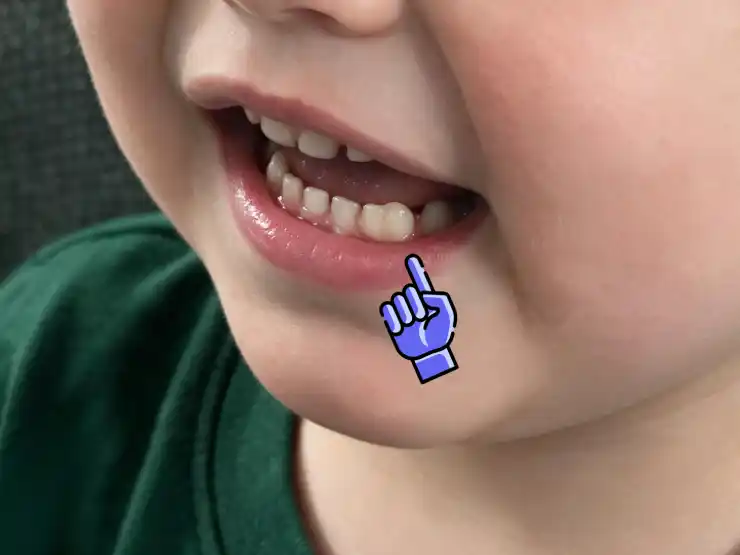
A fused baby tooth in the lower jaw where the lateral incisor and canine meet. It can happen in upper jaw teeth too, in general the front teeth are affected.
Here’s where dentistry gets pleasantly simple for once: you can actually work this out yourself, the same way your dentist does.
Two different things can produce what looks like one oversized tooth, and they happen for opposite reasons.
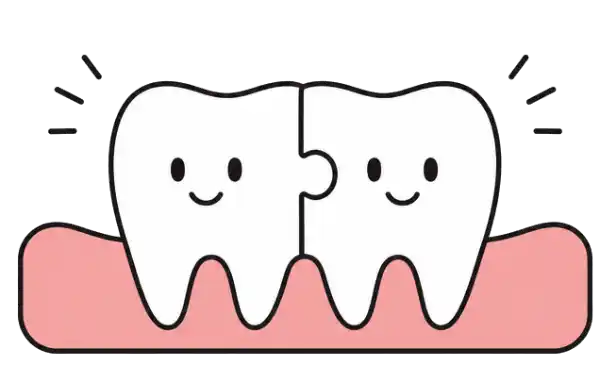
Fusion is exactly what it sounds like — two separate developing tooth buds physically merge into one during early development, most likely because they were growing close enough together that the tissue between them broke down and let them join. [1,2,5] Two teeth become one.
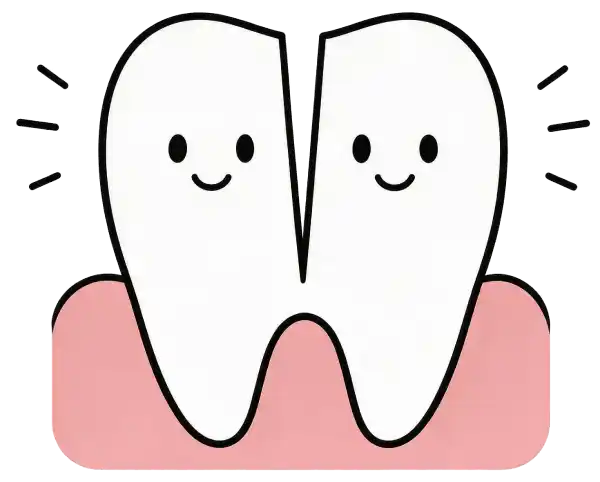
Gemination is the opposite direction entirely — a single tooth bud attempts to split into two and doesn’t quite finish the job, leaving one large crown with a groove suggesting a division that never fully happened. [5,9] One tooth trying and failing to become two.
Since they can look nearly identical from the outside, dentists lean on a simple counting trick, sometimes called the two-tooth rule: [2,9]
- Count every tooth in that section of the arch, treating the odd one as a single tooth.
- Fewer teeth than expected for that arch → it’s fusion. Two tooth buds merged into one, so the total count comes up short.
- A completely normal tooth count → it’s gemination. Nothing actually merged; one bud just tried to divide and produced an oversized single tooth instead.
There’s one wrinkle worth knowing, mostly so you’re not thrown off if your dentist mentions it: if a normal tooth fuses with an extra tooth your child wasn’t supposed to have in the first place, the count can look deceptively normal even though real fusion happened. [9] This is exactly why an X-ray matters more than a headcount in tricky cases — it shows whether there are two separate pulp chambers and root canals underneath (fusion) or just one (gemination). [6,9]
If you’re also tracking your child’s general eruption timeline and trying to figure out where this fits, the fused tooth is simply occupying the space where two separate baby teeth were supposed to sit — worth cross-checking against the teething chart if the timing seems off to you:
How rare is this, really 📊
Rare enough to be a genuine surprise. Common enough that it isn’t a medical first.
Across combined studies, fusion in baby teeth shows up in roughly 0.5% of children on average, with individual studies ranging anywhere from 0.1% to 5%. [1,4,5] It’s considerably rarer in permanent teeth — closer to 0.1%. [1,4,5] A Finnish study looking specifically at young children found joined primary teeth in about 0.7% of the group studied. [8]
It shows up almost exclusively in one specific spot. Fusion in baby teeth overwhelmingly involves the lower front teeth — specifically, the lateral incisor fusing with the canine right next to it. That single combination accounts for roughly 68% of all cases. [1,3,5] If your child’s fused tooth is somewhere else entirely, it’s not impossible, just considerably less typical.
Boys and girls are affected equally. [4,5] What does vary is ethnicity — children of Asian descent show meaningfully higher rates (roughly 1.5% to 3%) compared to children of European descent (closer to 0.1–0.9%). [2,5,8] Nobody fully knows why; it’s simply a documented pattern, not a cause-and-effect story anyone has nailed down.
Usually one side, occasionally both. Most cases affect just one side of the mouth. Genuine cases on both sides at once are rarer still — well under 1 in 1,000. [4,5]
Does it cause any actual problems 🛠️
Mostly, this is a cosmetic curiosity with a couple of practical footnotes worth knowing.
Cavities are the real, documented risk. The groove where two teeth joined together — visible or not — is an excellent trap for plaque and food. One study found cavities in 48% of fused primary teeth, most often in the specific fusion types with a deeper, more pronounced groove. [1,3,6] This is the actual reason a fused tooth needs a bit more attention at home, not because it’s fragile, but because it’s genuinely harder to keep clean than a normal tooth.
Gum health takes a similar hit for the same reason. The irregular shape gives plaque more places to hide near the gumline, which can mean a slightly higher risk of gum irritation if brushing isn’t thorough around that specific tooth. [1,5]
One related, but different, word you might hear: ankylosis. This is a separate condition where a tooth’s root actually fuses directly to the jawbone itself, rather than to another tooth — different mechanism, different implications, and not something this article is trying to cover in depth. If your dentist mentions it specifically about this tooth, that’s a distinct conversation worth having with them directly rather than assuming it’s the same thing as tooth-to-tooth fusion.
Space and bite considerations exist, but they’re manageable. Because the fused tooth is physically wider than a normal tooth would be, it can occasionally contribute to crowding or spacing irregularities in that section of the arch. [2,5] This is something to have on your radar for the mixed-dentition years, not something requiring action today.
Will it affect the adult tooth underneath 🔮
This is the section that actually matters most, and it’s the one most content on this topic skips entirely.
Fused baby teeth are a genuine predictor of what happens with the permanent teeth coming in behind them — not a guarantee of trouble, but a real statistical flag. Studies following these children found that up to 85% had some kind of anomaly in their permanent dentition. [3,8]
The most common finding, by a wide margin: the permanent successor tooth never develops at all — a condition called hypodontia — showing up in somewhere between 65% and 76% of these cases, especially when the fusion involved the lower lateral incisor and canine. [3,8]
Other patterns that show up less often but are still worth knowing:
- Peg-shaped lateral incisors — a permanent tooth that comes in noticeably smaller and more tapered than normal
- Talon cusps — an extra, claw-like point of enamel on a tooth that isn’t usually there
- Extra (supernumerary) teeth
- Delayed or oddly positioned eruption of the permanent tooth that is supposed to replace the fused one.
None of this is something you can predict or prevent by anything you do at home. It’s simply useful information for your dentist to have on file, so if the adult tooth is late, missing, or oddly shaped years from now, nobody’s starting from scratch trying to explain why.
What to actually do about it 🛠️
If the tooth is healthy and cavity-free right now:
- Mention it, get it documented, and let your dentist keep an eye on it — typically with more frequent check-ins, often every few months rather than the standard schedule. [2,6]
- Ask about a fluoride treatment and sealing the groove where the two teeth joined — a straightforward, preventive step that directly targets the cavity risk described above. [2,6]
- Brush that specific tooth a little more deliberately than the others. The groove is exactly the kind of spot a toothbrush can miss if you’re moving quickly.
If a cavity has already formed:
- Standard restoration — cleaning out the decay and filling it — works the same way it would for any other tooth. [2,6]
- For a more visible front-tooth fusion, your dentist may use a shaping technique with layered composite to make the restored tooth look more like two natural teeth rather than one wide one, if that’s a priority for you and your child. [2,6]
If the tooth becomes genuinely mobile, badly decayed, or is blocking the permanent tooth from coming in properly:
- Extraction becomes the right call at that point, not before. [2] If there’s no permanent successor tooth at all — which, given the hypodontia numbers above, is a real possibility here — dentists generally try hard to keep the fused baby tooth functioning for as long as possible, sometimes well into the teenage years, until your child is old enough for a permanent prosthetic solution. [2].
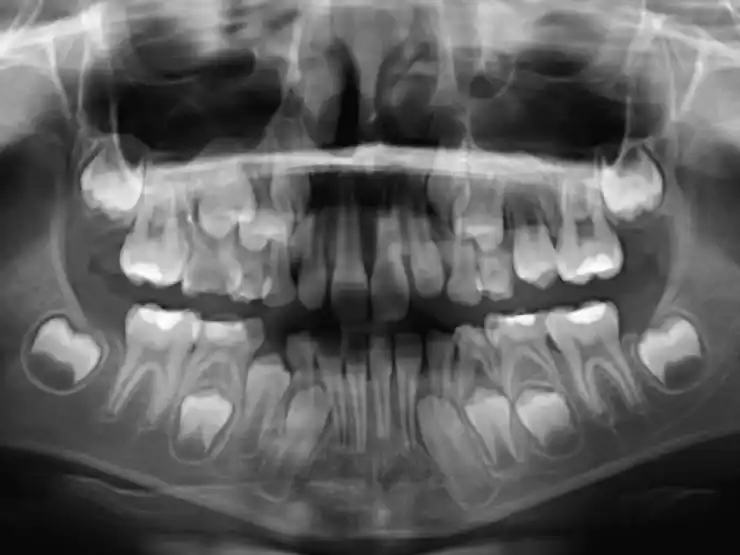
X-ray can reveal the presence or absence of permanent successor teeth.
Either way: get an X-ray at some point during this process. It’s the only reliable way to see whether a permanent successor is developing at all underneath, which is genuinely the most useful piece of information in this entire situation. [2,10] An X-ray is also the right move any time a baby tooth is doing something unexpected — whether that’s fusion, a tooth that’s changed color after a bump , or anything else that doesn’t match what you were expecting to see.
Bottom line 🎯
A fused baby tooth is two tooth buds that merged early in development — uncommon, mostly cosmetic, and almost always confined to one specific spot: the lower lateral incisor and canine. [1,3,5] The immediate risks are manageable and well understood — a slightly higher chance of cavities and gum irritation, both addressed with the same tools you already use, just a bit more deliberately. [1,3,6]
The part actually worth your attention isn’t the tooth in front of you — it’s the one that may or may not show up behind it. A fused baby tooth is a real, documented signal that the permanent successor might be missing, unusually shaped, or delayed. That’s not a reason to worry today. It’s a reason to make sure your dentist has this on record and is watching for it, calmly, over the years ahead.
Related Reads 🔗

Baby Teething Chart by Age: Interactive Timeline + 101 Guide
See when baby teeth come in with our interactive teething chart. Select your child’s age and explore eruption timelines and tooth replacement.

Tooth Growing in Behind Baby Tooth? Shark Teeth Explained
Two rows of teeth out of nowhere isn't a crisis. Dentists call it shark teeth. Here's what's actually happening — and when it's worth a call.
Baby Tooth Turned Grey After a Fall? What It Means
No pain doesn't mean no problem. A grey baby tooth after a bump is a bruise on the inside. Here's what's normal and what needs a dentist.
Sources
- [1] AlKlayb SA, Devang Divakar D. An Uncommon Tooth Fusion of Mandibular Primary Lateral Incisor with Canine. *Clinics and Practice*. 2021;11(1):106-109. DOI: 10.3390/clinpract11010016
- [2] Bernardi S, Bianchi S, Bernardi G, et al. Clinical management of fusion in primary mandibular incisors: a systematic literature review. *Acta Odontologica Scandinavica*. 2020;78(6):417-424. DOI: 10.1080/00016357.2020.1734233
- [3] Açıkel H, İbiş S, Şen Tunç E. Primary Fused Teeth and Findings in Permanent Dentition. *Medical Principles and Practice*. 2018;27(2):129-132. DOI: 10.1159/000487322
- [4] Duncan WK, Helpin ML. Bilateral fusion and gemination: A literature analysis and case report. *Oral Surgery, Oral Medicine, Oral Pathology*. 1987;64(1):82-87. DOI: 10.1016/0030-4220(87)90121-6
- [5] Babaji P, Prasanth MA, Gowda AR, Ajith S, D'Souza H, Ashok KP. Triple Teeth: Report of an Unusual Case. *Case Reports in Dentistry*. 2012;2012:1-3. DOI: 10.1155/2012/735925
- [6] Merli Aldrigui J, Cinthia Silva A, Cardoso Guedes C, Kalil Bussadori S, Turolla Wanderley M. Endodontic and restorative treatment of fused primary anterior teeth — Case report. *Pediatric Dental Journal*. 2011;21(1):85-89. DOI: 10.1016/s0917-2394(11)70232-4
- [7] Thakkar D. Images in Medicine: Triplicated Primary Anterior Teeth - A Report of Two Cases. *Journal of Clinical and Diagnostic Research*. 2016. DOI: 10.7860/jcdr/2016/16249.7253
- [8] Järvinen S, Lehtinen L, Milen A. Epidemiologic study of joined primary teeth in Finnish children. *Community Dentistry and Oral Epidemiology*. 1980;8(4):201-202. DOI: 10.1111/j.1600-0528.1980.tb01286.x
- [9] Munshi AK, YR. Gemination Or Fusion? A Diagnostic Dilemma. *Dentistry*. 2014;04(02). DOI: 10.4172/2161-1122.1000196
- [10] Khan R, Kariya PB, Mallikarjuna R, Singh AN. Fusion of permanent maxillary right central incisor and mesiodens in an 8-year-old child. *BMJ Case Reports*. 2015;2015:bcr2014208541. DOI: 10.1136/bcr-2014-208541
FAQ: Fused Baby Teeth: Real Answers ❓
How rare is a fused baby tooth?
What causes baby teeth to fuse together?
What does a fused baby tooth actually look like?
Can a fused tooth be separated or fixed?
What complications can fused teeth cause?
Are fused teeth genetic?
Will a fused baby tooth affect the adult tooth underneath it?
👶 Part of our Kids Dental Health Guide
This article is part of our Kids Dental Health Guide, where we break down the most common dental problems in children and how to actually deal with them.
About the Author: DMD Alexander K.
Doctor of Dental Medicine with clinical experience treating adults and children. This site focuses on practical prevention, symptom education, and helping patients make informed decisions.
Learn more on the About page.