Root Canal or Extraction for Your Child's First Molar?
Last Updated: July 21, 2026
🕒 15 min read

Written by DMD Alexander K.
Doctor of Dental Medicine, 10+ years of clinical experience, focused on preventive dentistry and patient education. Learn more on the About page.
Table of Contents
Your dentist said “root canal or extraction” — now what? 🦷
You went in for a cavity check. You left with a decision that sounds a lot bigger than “cavity check” implied.
The filling isn’t enough anymore, the caries moved into the pulp, and now your dentist is saying:
“We can try to save it with a root canal, or we can just take it out.”
Here’s the part most parents never get told in that eleven-minute appointment: saving the tooth is not automatically the better outcome.
For this specific tooth, at this specific age, extraction is frequently the smarter long-term call — not the consolation prize.
That’s not the popular answer. It’s the honest one, and it depends heavily on one thing your dentist should be checking on an X-ray, not guessing at.
Why this tooth is different from an ordinary cavity call 🦷
If your dentist is talking about “the first molar,” they almost certainly mean the first permanent molar — the six-year molar, so named because it typically erupts around age 6, usually without any baby tooth announcing its arrival first. If you want the full eruption picture, the teething chart lays out the whole sequence.
This tooth is permanent.
There’s no successor tooth waiting behind it.
Whatever happens to it now is largely what happens to it for the next several decades —
which is exactly why “just pull it and move on” and “save it no matter what” are both oversimplified answers.
The actual right call depends on a factor most articles on this topic skip entirely: what’s happening with the second molar, developmentally, right behind it.
👶 Part of our Kids Dental Health Guide
This article is part of our Kids Dental Health Guide, where we break down the most common dental problems in children and how to actually deal with them.
Here’s why that matters so much.
If the first molar is extracted at the right developmental moment, the second permanent molar —
still developing, not yet erupted — will drift forward and erupt into the first molar’s spot, effectively replacing it.
No gap.
No prosthetic tooth needed decades later.
The body does the fix for free, if the timing is right.
Miss that window, and you lose the option.
The second molar erupts into its own position, the gap behind it stays a gap, and now you’re managing a permanent missing-tooth problem with a bridge or an implant instead of nothing at all.
What actually happens: root canal vs. extraction, explained plainly 🔬
Let’s get the terminology straight, because “root canal” covers more than one actual procedure here, and they do not perform the same.
Pulpotomy (partial or coronal) — only the infected portion of the pulp gets removed; the rest is left intact and treated with a material that encourages the tooth to keep healing. This is only an option when the deeper pulp tissue is still healthy — meaning the infection hasn’t progressed too far. [4]
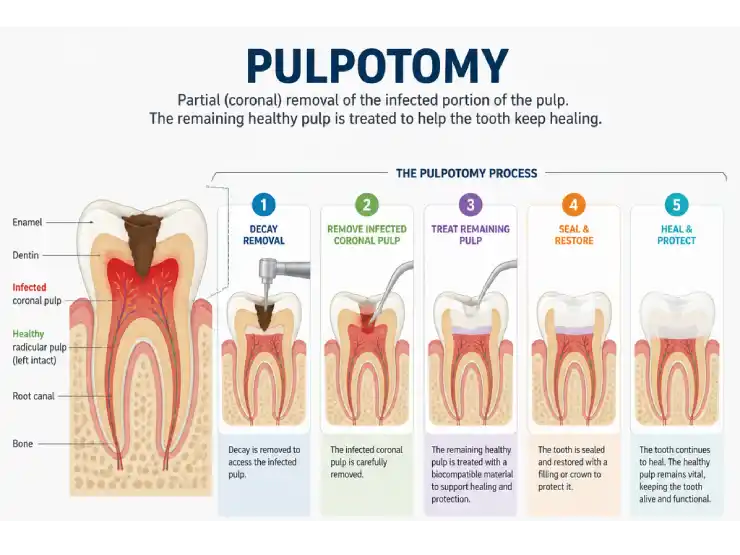
Pulpotomy removes only the infected portion of the pulp, leaving the rest intact so the tooth is still vital. Conditions must be right for this to be an option, and procedure needs to be done well.
Pulpectomy (conventional root canal treatment) — all the pulp, crown and roots, gets removed because the infection has already gone too deep for a partial approach. This is what’s usually meant by “full root canal.”
The uncomfortable truth about success rates, by procedure:
-
Pulpotomy: genuinely good news.
Partial pulpotomy succeeds in roughly 91% of cases, coronal pulpotomy around 90%, tracked over an average of two and a half to three years. [4]
This held up regardless of the tooth’s root maturity or the initial severity of the pulpitis. [4]
If your child’s tooth qualifies for this — meaning the infection hasn’t reached the root pulp — this is a genuinely strong option.
But the dentist needs good assessment skills to determine if the infection is limited to the crown pulp, and the procedure needs to be done well, or the success rate drops. -
Pulpectomy: considerably less reassuring.
One review of conventional root canal treatment specifically on first permanent molars in children found a success rate of just 36%. [4]
Broader studies of root-filled permanent teeth in teenagers found that 52% to 67% of treated molars showed signs of ongoing infection (apical periodontitis) at follow-up — worse than premolars, and far worse than front teeth. [1,2]
For comparison, adult root canal treatment on similar teeth succeeds around 87% of the time. [4]
Teenage molars are simply a harder tooth to treat successfully, for reasons covered below.
Why the gap between pulpotomy and pulpectomy is so wide, practically:
Pulpotomy only gets offered when the infection is limited enough to qualify for it — which, in real-world practice, isn’t the majority of cases that end up in this conversation. Most parents facing this decision are facing it because the infection has already progressed past the point where pulpotomy is on the table. [8] So while pulpotomy’s numbers look great, they often don’t apply to the specific tooth in front of you — and if your dentist is recommending a full pulpectomy instead, you’re looking at closer to a coin-flip outcome, not a guaranteed save.
Why full root canal treatment specifically struggles in this age group:
- Young permanent molars have wider, less predictable root canal anatomy than adult teeth, making them genuinely harder to clean and seal completely. [2]

- The technical quality of root canal fillings in teenagers is frequently inadequate — one study found only about 40% were filled to an acceptable technical standard, and teeth with a poor seal had 6 times higher odds of ongoing infection. [1,2]
- Cooperation matters more than people assume. A fidgety, anxious 9-year-old makes it genuinely harder to keep the tooth isolated and dry throughout a long procedure — and that directly affects how well the filling seals. [4]
- Many of these teeth are also affected by a condition called molar incisor hypomineralisation (MIH), which makes the enamel weaker and restorations less predictable to bond, independent of the root canal itself. [8]

The real tradeoffs — cost, timeline, and what happens if you just pull it 💰
This is the section that actually deserves your full attention, because “save the tooth” sounds like the responsible choice and isn’t always the smart one.
Here’s the scenario nobody walks parents through:
the “successful” root canal that still fails you later.
Say the pulpectomy goes reasonably well.
The tooth is saved — for now.
Root canal-treated teeth don’t come with a lifetime guarantee, and this specific tooth, in this age group, has a track record of gradually declining rather than lasting indefinitely.
If it eventually fails — and given the numbers above, that’s a real possibility, not a remote one — your child (future adult) is now facing extraction anyway,
except years later, once growth has finished and the second molar has long since erupted into its own permanent position.
At that point, spontaneous space closure is no longer possible.
The gap is permanent, and the only fixes are a dental bridge or a dental implant — both expensive,
both requiring maintenance for the rest of your child’s life, neither one as good as a natural tooth.
Run that scenario forward: a root canal today that fails in ten years leaves a 21-year-old staring down a bridge or implant decision that a well-timed extraction, back when they were 9, would have completely avoided.
Compare that to extraction, timed correctly.
Pull the tooth while the second molar is still developing,
and the second molar erupts forward into the space, essentially becoming the new “first molar” position.
No prosthetic.
No decades-long maintenance.
No bridge conversation at 21.
The body closes the gap on its own, permanently, for free.
This is why “extraction” isn’t the lesser option here — it’s frequently the more durable one, when the timing lines up.
One correction worth being direct about:
you may have read elsewhere — including in earlier advice on topics like this —
that a space maintainer should go in after pulling a molar.
That advice is correct for a baby tooth, where the goal is holding space open for a permanent tooth still to come.
It is the wrong advice here.
This is a permanent tooth with no successor.
If the extraction happens at the right developmental moment, a space maintainer would actually work against the goal —
it would hold a gap open that you want to close naturally via the second molar drifting forward.
Space maintainers belong in a completely different clinical scenario than this one.
What extraction costs you, honestly:
time in the chair for the extraction itself, and — if the timing was off, or the second molar has already erupted —
the space closure won’t happen on its own, and orthodontic treatment or a prosthetic replacement becomes the actual path forward instead. [8]
The choice isn’t “extraction, free and easy” versus “root canal, expensive but guaranteed.”
It’s a legitimate, timing-dependent tradeoff either way.
Does your child’s age actually change the decision? 🎂
Here is the most important section in this article.
The tooth’s condition matters.
But,
timing relative to the second molar’s development is what actually determines whether extraction is a smart move or a costly mistake.
The developmental marker that matters:
root bifurcation of the second molar.
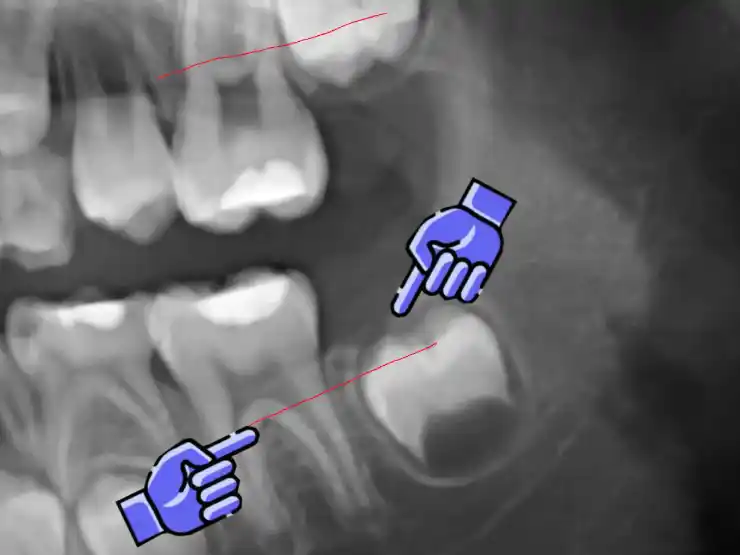
This X-ray is for illustration only — this particular first molar isn't actually in a condition that requires extraction. The two pointers mark the key landmarks: the left one shows where the first molar's roots split apart (the bifurcation), and the right one shows the second molar's crown still developing beside it. The red line marks how far the second molar has already grown past that bifurcation point of the first molar. Ideally, the first molar extraction happens before the second molar's crown has passed that red line. Still, in this specific case, there is a great chance it will close the gap naturally if the first molar is extracted, because the second molar bifurcation hasn't formed yet, no H shape.
Your dentist assesses this on an X-ray, not by guessing your child’s age.
But the age range where this is most relevant is roughly 8 to 10 years old, because that’s when the second molar’s roots are typically still forming, but 11 and 12-year-olds should also be considered.
What they’re looking for is whether the second permanent molar’s roots have started to divide — the root bifurcation — behind the first molar. [8]
- If the second molar’s root bifurcation hasn’t formed yet, or is just beginning to appear, there’s still a strong developmental window for that tooth to drift forward and close the gap on its own if the first molar is extracted now. This tends to fall in roughly the 8 to 10 year-old range, though it’s genuinely determined by the X-ray, not the birthday. [8]
- Once that root bifurcation is well established and the second molar is erupting or has erupted, that window is closing or already gone. Extraction at that point won’t trigger the same spontaneous closure — the second molar is already committed to its own position in the arch. This is precisely why “how old is my kid” isn’t the real question. Two 9-year-olds can be at completely different developmental stages for this specific purpose. The X-ray, not the calendar, tells you whether extraction now buys you a self-closing gap or a permanent one.
What this means practically, laid out plainly:
- Tooth has limited infection, qualifies for pulpotomy, second molar isn’t ready anyway → pulpotomy is a strong, well-supported choice. [4]
- Tooth needs a full root canal (pulpectomy), and the second molar’s root bifurcation hasn’t developed yet → this is genuinely the scenario worth having an honest conversation about extraction instead, given pulpectomy’s modest success rate in this exact situation and the fact that a well-timed extraction could close the space naturally, permanently, at no future cost. [1,2,4,8]
- Tooth needs extraction and the second molar has already erupted or is close to it → the self-closure window is gone; extraction is still often the right call if the tooth is failing, but expect a conversation about orthodontic space management or eventual prosthetic replacement rather than a free natural fix. [8] Behavior and cooperation still matter, separately from all of the above. A young or anxious child may not tolerate the longer procedure and rubber dam isolation that root canal treatment requires — and rubber dam use alone has been shown to meaningfully improve success rates, meaning a child who can’t cooperate with it is already starting from a disadvantage regardless of which procedure is chosen. [4]
What are other factors that affect the decision?
Some other factors play the role too, not just the famous “bifurcation” word.
Just to be clear, we are still talking about pulling out a permanent first molar, and closing the gap with the second molar.
Upper jaw has a greater success rate (85 %) than lower jaw (50 %) due to the bone density.
Presence of the wisdom tooth (third molar) is also a factor.
Second molar is a pushover in relation to the wisdom tooth.
If the wisdom tooth is present, it can drift forward and close the gap after the first molar extraction.
The angle of the second molar eruption path is also something to be considered. Also if a orthodontic treatment is a option for you and your child, that plays a role in the decision making too.
Many factors your dentist would need to consider, and still this text is about helping you to make a informed decision, and not to replace the dentist’s advice.
What to ask your dentist before you say yes to either one ❓
Walk in with these, and you’ll get a genuinely useful conversation instead of a rushed either/or.
- “Is this tooth a candidate for pulpotomy, or does it need a full pulpectomy?” This single answer moves you from a 90% success conversation to a much more uncertain one. [4]
- “Can you check my child’s X-ray for the second molar’s root development — specifically, has the root bifurcation started to form?” This is the question that actually determines whether extraction offers a free, natural fix or leaves a permanent gap. [8]
- “If we extract now, do you expect the second molar to drift forward and close the space on its own?” Get a direct answer, not a vague one — this is the entire point of the timing conversation.
- “If we do the root canal and it eventually fails, what does that look like for my child at 18 or 21?” Make the long-term scenario concrete instead of abstract.
- “Does this tooth show signs of MIH or weakened enamel that might affect how well a restoration holds up regardless of the root canal?” [8]
- “If extraction happens after the ideal window has passed, what’s the plan for that space?” [8] A dentist who can answer the root-bifurcation question specifically, rather than defaulting to “let’s just try to save it,” is giving you the real decision — what actually separates a thorough dentist from a rushed one matters enormously here, arguably more than in almost any other pediatric decision on this site.
Bottom line 🎯
Saving this tooth is not automatically the win it sounds like. Pulpotomy, when the tooth qualifies for it, is genuinely excellent — around 90% success. [4] Full root canal treatment (pulpectomy) on this exact tooth, in this age group, is a coin flip at best — success rates as low as 36%, and apical periodontitis showing up in over half of treated molars in follow-up studies. [1,2,4]
The real deciding factor isn’t “root canal versus extraction” in the abstract. It’s whether the second molar’s root bifurcation has developed enough, on X-ray, for that tooth to drift forward and close the space naturally if the first molar comes out now. Catch that window, and extraction isn’t a loss — it’s the tooth fixing itself, permanently, for free. Miss it, and you’re managing a gap with orthodontics or a prosthetic down the line regardless of which path you took to get there.
And one thing worth remembering plainly: a space maintainer does not belong in this conversation the way it does for a baby tooth. If your dentist mentions one for a permanent first molar extraction, ask why — the answer should be about a missed developmental window, not a default habit.
There’s no universal right answer here. There is a right X-ray to ask for before anyone commits to either path.
Related Reads 🔗
- Baby Teething Chart: Full Eruption Timeline
- Do You Need a Dental Crown?
- How to Find a Good Dentist: 10 Trustworthy Signs
- Kids Dental Health — Full Topic Guide


Sources
- [1] Gumru B, Tarcin B, Pekiner FN, Ozbayrak S. Retrospective radiological assessment of root canal treatment in young permanent dentition in a Turkish subpopulation. *International Endodontic Journal*. 2011;44(9):850-856. DOI: 10.1111/j.1365-2591.2011.01894.x
- [2] Ridell K, Petersson A, Matsson L, Mejàre I. Periapical status and technical quality of root-filled teeth in Swedish adolescents and young adults. A retrospective study. *Acta Odontologica Scandinavica*. 2006;64(2):104-110. DOI: 10.1080/00016350500367637
- [3] Brunton PA. Summary of: The failure rate of NHS funded molar endodontic treatment delivered in general dental practice. *British Dental Journal*. 2008;204(5):254-255. DOI: 10.1038/bdj.2008.177
- [4] Taylor GD, Vernazza CR, Abdulmohsen B. Success of endodontic management of compromised first permanent molars in children: A systematic review. *International Journal of Paediatric Dentistry*. 2019;30(3):370-380. DOI: 10.1111/ipd.12599
- [5] Lee AHC, Cheung GSP, Wong MCM. Long-term outcome of primary non-surgical root canal treatment. *Clinical Oral Investigations*. 2011;16(6):1607-1617. DOI: 10.1007/s00784-011-0664-2
- [6] Fernández R, Cardona JA, Cadavid D, Álvarez LG, Restrepo FA. Survival of Endodontically Treated Roots/Teeth Based on Periapical Health and Retention: A 10-year Retrospective Cohort Study. *Journal of Endodontics*. 2017;43(12):2001-2008. DOI: 10.1016/j.joen.2017.08.003
- [7] Ridell K, Matsson L, Mejàre I. Background factors associated with endodontic treatment due to caries in young permanent teeth. *Acta Odontologica Scandinavica*. 2007;65(4):219-223. DOI: 10.1080/00016350701364904
- [8] Lakhani S, Noble F, Rodd H, Cobourne MT. Management of children with poor prognosis first permanent molars: an interdisciplinary approach is the key. *British Dental Journal*. 2023;234(10):731-736. DOI: 10.1038/s41415-023-5816-7
FAQ: Root Canal or Extraction for a Child’s Molar: Real Answers ❓
What is the youngest age a child can get a root canal?
Is it bad for a child to get a root canal, long-term?
What's the alternative to a root canal for a child's molar?
Do kids get sedated or put to sleep for a root canal?
What happens if you just extract the tooth instead?
Does losing this molar early cause problems later?
Do I need a space maintainer after extracting this tooth?
How painful is a root canal for a child compared to an extraction?
👶 Part of our Kids Dental Health Guide
This article is part of our Kids Dental Health Guide, where we break down the most common dental problems in children and how to actually deal with them.
About the Author: DMD Alexander K.
Doctor of Dental Medicine with clinical experience treating adults and children. This site focuses on practical prevention, symptom education, and helping patients make informed decisions.
Learn more on the About page.