Does Teething Cause Fever? Why Not and When to Worry
Last Updated: April 21, 2026
🕒 6 min read

Written by DMD Alexander K.
Doctor of Dental Medicine, 10+ years of clinical experience, focused on preventive dentistry and patient education. Learn more on the About page.
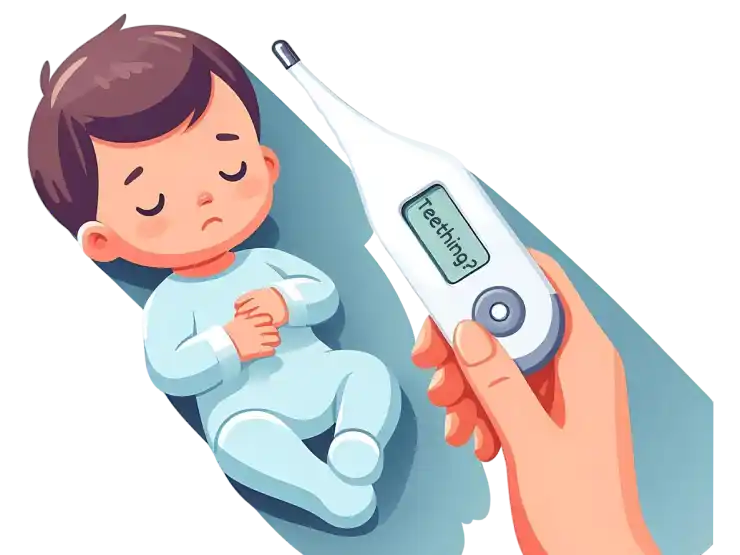
Table of Contents
Teething fever - Quick Info 🚀
Does teething cause fever? The short answer: no.
Probably you already read that somewhere.
Still, you are not convinced.
Teething is to blame for the fever, right?
Tooth coming in → baby gets fever → case closed.

But that’s like blaming ice cream for car accidents in summer. 🍦
We can continue our love for the ice cream, because it’s not the one causing the crashes.
It’s just that more people are out driving when it’s hot and sunny, and they tend to eat more ice cream as well.
Teething and fever often occur simultaneously.
That doesn’t mean one causes the other.
So why does it feel like it does? 🧬
Because you’re not completely wrong.
Teething
is a complex process, where something called Interleukin-1
is released while teething to elevate local temperature so the process can work its magic.
But sometimes it causes a slight increase in body temperature.
Their job is to slightly increase the local temperature so the tooth can break through.
That can cause a tiny rise in body temperature.
But here’s the line you don’t cross:
👉 Teething does NOT cause a real fever.
- Slight temperature rise → possible
- Fever ≥ 100,4°F (38°C) → not teething
If it hits 100,4°F (38°C) or more, something else is going on.
What counts as a real fever? 🌡️
Let’s keep it brutally simple:
- Below 100,4°F (38°C) → not a real fever
- 100,4°F (38°C) or higher → real fever
Teething lives below that line.
Anything above it?
Not teething. Not even close.
What is teething’s alibi for the fever? ⏱️
Timing.
Teething usually starts when babies begin to:
- touch everything
- put things in their mouth, clean and unclean alike
- start with solid foods, which can introduce new bacteria
- share germs with the entire planet 🌍
So when a tooth shows up, and fever follows…
Your brain connects the dots.
But correlation ≠ causation.
When do babies start teething? 🦷
Most babies start around 6 months.
Some earlier. Some later. All normal.
Teething continues until around 2.5–3 years.
It comes in waves. Not a constant battle.
Want to see exactly what’s happening by age?
👉 Check Out Interactive Teething Chart
Also, once teeth show up, don’t forget what comes next:
👉 When To Start Brushing Baby Teeth
What teething actually causes 😬
Teething is uncomfortable — but it’s not dangerous.
There’s even a defined “teething window”:
- 4 days before
- day of eruption
- 3 days after
That’s your 8-day window.
Study shows these are the most common symptoms:
- chewing everything in sight 🧸
- drooling (a lot) 🤤
- gum rubbing 🪥
- irritability 😣
- wakefulness 🌙
- ear pulling 👂
- facial rash 🔴
- decreased appetite for solid foods 🍽️
- slightly higher temperature (not fever) 🌡️
That’s it. No plot twist.
What is NOT from teething 🚫
This is where things get messy — and dangerous if ignored.
🔥 High fever (≥ 100,4°F (38°C))
We covered that already, but it’s worth repeating.
Not teething.
Don’t overthink this — use simple rules:
- fever ≥ 100,4°F (38°C)
- lasts > 24h
- baby looks off
- your gut says something’s wrong
Call your pediatrician and schedule a checkup.
You’re not overreacting. You’re paying attention.
💩 Runny poop
Study
shows it’s not related.
Still, many parents report it, and this can be explained in the same way as with a fever.
Drooling is indeed intense during teething, the saliva has a different composition,
and it may cause some irritation in the diaper area.
Still, the valid cause is that in this period, babies are more likely to put everything in their mouths,
and they are more likely to pick up viruses that cause diarrhea.
Not teething.
Also, the solid foods are introduced in this period, and they can cause some changes in the stool.
It’s a mixture of everything, you can’t isolate only one cause.
So the causes can be many, but the important takeaway is that - don’t ignore diarrhea just because you think it’s “just teething.”
So the important rule is:
Diarrhea is never “just teething.”
Diarrhea is still diarrhea, and it can cause dehydration, The most important complication that you need to look out for.
If your baby doesn’t take enough fluids, it’s an urgent situation. Just head to the doctor without much googling on the web.
Watch hydration.
If fluids drop → act fast.
🔴 Nappy rash
Same as with runny poop, many parents report nappy rash during teething.
The most likely cause is the same as with runny poop -> drooling and saliva irritation.
Or better said, nothing you can do about it.
Which leaves you to keep the area clean, dry, and use some barrier cream if needed.
Manage it — but don’t ignore it.
🤢 Vomiting
Also not teething.
This is not a “wait and see” symptom.
Vomiting is a serious symptom in babies (not burping type of “vomiting”),
it can also cause dehydration, and it can be a sign of other illnesses.
Don’t explain it away. Check it.
😷 Coughing
Not teething.
Likely infection.
Especially if paired with fever or breathing changes.
The real problem 🧠
Teething is convenient.
It explains everything.
Too convenient.
So parents use it as a blanket diagnosis.
But that’s risky.
Because real problems hide behind it.
Zooming out (why this matters) 🔗
Teething is just one part of oral development.
If you want the full picture, start here:
👉 Kids Dental Health Covered
And while you’re at it:
- Thumb sucking habits? → 👉 Check out how to stop thumb sucking
- Breastfeeding myths? → 👉 Breastfeeding can cause cavities in babies, really?!
Same pattern everywhere: Assumptions → myths → confusion.
Bottom line 🎯
Teething gets blamed for everything.
Fever, diarrhea, coughing, vomiting…
It didn’t do most of it.If your baby has real symptoms:
Don’t label it.
Don’t guess.
Don’t Google for comfort.
If your baby has any of those symptoms, don’t just assume it’s “teething.”
Pay attention to the details. Most of the time is something that just needs to run its course. But if you see something that’s not right, trust your instincts. And when in doubt, call your pediatrician.
Although…
When the baby bites you, that’s definitely teething.
That’s a fact. 🍀
Quick FAQ: Teething fever ❓
How to tell if a fever is from teething?
Is a fever 102.2 teething?
How do you break a teething fever?
Should you give Tylenol for teething?
What can be mistaken for teething?
Do teething fevers get high?
How long does teething fever last in kids?
What stage of teething hurts the most?
Is teething pain worse at night?
How much temperature is normal in teething?
What's the highest fever from teething?
About the Author: DMD Alexander K.
Doctor of Dental Medicine with clinical experience treating adults and children. This site focuses on practical prevention, symptom education, and helping patients make informed decisions.
Learn more on the About page.